Gurus and Gurukulams

Distinguished Guest Column By Lakshmi Vishwanathan I think it was Rabindranath Tagore who first established Santiniketan as a campus for the Arts. Perhaps Rukmini Devi was inspired by that. Her husband Bishop Arundale played a significant part in giving it an international profile, envisaging a composite multidisciplinary educational programme. Fortunately both institutions have survived the ravages of time. Both are over sixty years old. Poet Vallathol laid the ground work for Kerala Kalamandalam, focusing on Kathakali and allied arts in the lush setting of Cheruthuruthi, on the banks of the Bharatapuzha river. Kalamandalam too has stood the test of changes. Later institutions have sprung up in other parts of India, like Odisha, and Karnataka and are trying their best to fulfill the need for art campuses. Some are crying out loud:”Where have all the Gurus gone?”We may wonder as to how successfully these institutions filled the gap created by the gradual fading away of the original Gurus and Gurukulams/Gurukuls. The old system relied on one Guru for a chosen set of pupils. Take the case of Bharatanatyam…. In their ancestral villages, Nattuvanars taught dance in what is known as the “Silambukoodam”, where young girls learnt not only dance but also music and languages. From dawn to dusk, they had a scheduled life of training and were eventually presented in performance only when the Guru felt they were ready. They learnt everything that needed to be known to become dancers, from their versatile Guru, who sang, played instruments and also composed dances. Nothing was written in books. Like learning the Vedas, repeated practice ensured creditable knowledge. When Gurus left the villages of Tanjavur and came to Madras, their survival depended on new students. They modified the Gurukulam system. However they demanded undivided attention from students and put them through intense learning. I myself spent the best part of everyday in my Guru Kanjivaram Ellappa’s house and Guru Vempatti Chinna Satyam’s class, to learn not only dance, but the music that I danced to. Such Gurus allowed us to observe their teaching and also inspired us with their uncompromising standards of excellence. Guru Ellappa a prolific singer, insisted on my singing the song be it Varnam or Padam perfectly with all nuances in place, before moving even a step to dance to it. The accent was on becoming a skillful and intelligent dancer, with a deep understanding of the music and lyrics. Kalakshetra began with classes taught by the traditional Gurus, including the most famous Pandanallur Meenakshisundaram Pillai. But Rukmini Devi a pioneer of modern Indian culture also had the foresight to institutionalize the teaching, with separate music teachers. She also included allied arts like drawing, painting, and later other dance forms like Kathakali. She never conducted an Arangetram! The five year course gave a diploma, and later a post diploma meant to equip students with a basic knowledge of theory as well. The interesting thing is most of her early teachers from hereditary families had experienced the real Gurukulam. So they brought that ethos to the first few batches of students. Rukmini Devi even ensured a village atmosphere with classes and homes sheltering students under thatched roofs. Kalakshetra equipped students to face the stage in their own campus, and gave them opportunities to perform in dance-dramas based on their respective abilities. Above all they were given very good teacher-training. Thus it is that although many stars did not come out of Kalakshetra, any number of mini Kalakshetras have been functioning everywhere for the past several decades. Kalamandalam has ensured that the intricate dance –drama tradition of Kathakali is alive and well. Their campus may be drawing fewer full time students, but scholarships help in moulding committed students. Big names in the dance form, its special Sopanam music, and in the various percussion instruments like Chenda and Maddalam have been the resident Gurus and continue to be there. The kind of all round training, as well as the special oil massages that young students need to have for strengthening their bodies is possible only in such a campus. Their theatre, Koothambalam is one of the finest for that Kerala architectural ambience. Their performing troupe is busy both in India and abroad.Dance villages purporting to be Gurukulams cannot survive without three important aspects : Gurus of stature, funding from Government, and student response. We are yet to dream of Dance universities. Students of dance are gradually navigating to scholarship, research, writing, and other dance-oriented activities. After all everybody cannot be a star dancer or eminent Guru. Time will tell what modern India does to our dance heritage.Lakshmi Vishwanathan is an eminent dancer and author.
Shivangi Dake Robert Interview
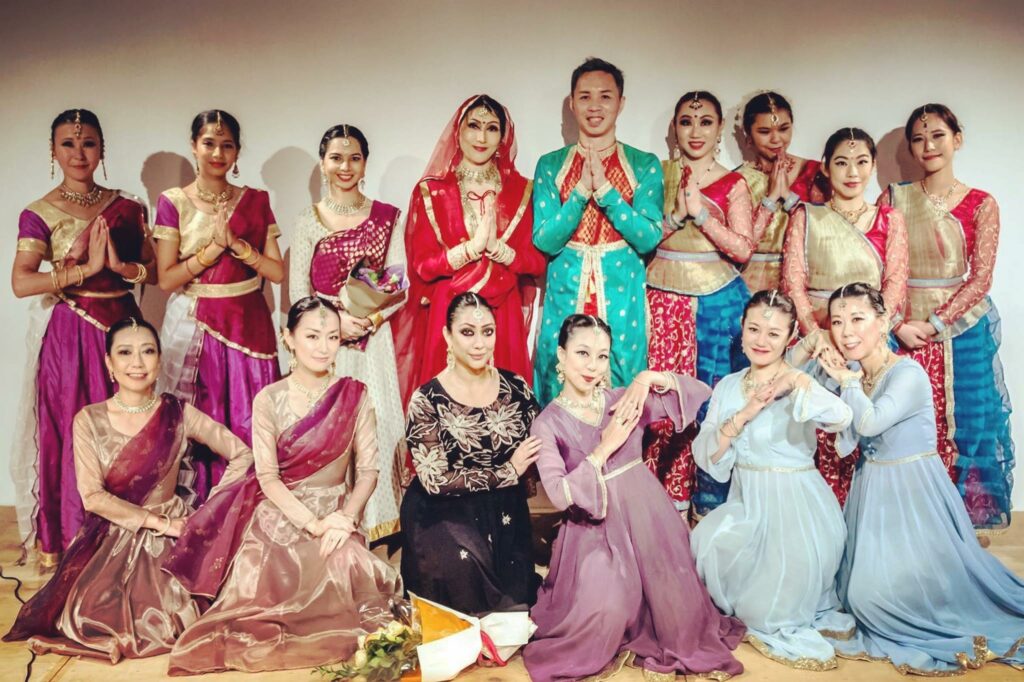
“Dance is joy,” a tete-e-tete with Shivangi Dake Robert, Kathak faculty and senior dancer By Vidhya Nair “Dance is joy. Teaching children has been particularly joyful. I’m really enjoying it. They have a blank slate and absorb easily without inhibitions. It’s also a joy to teach passionate adults who are very keen to learn. Thanks to social media especially during this Covid19 pandemic it has been very useful to reach out and spread the art. It’s a small way to engage new audiences to Kathak. To spark an interest and makes them interested to come to a workshop and come to a class. It’s also a good space to learn from other people.” Says Kathak faculty of the Academy and senior dancer of Apsaras Arts Dance Company in this exclusive tete-e-tete with Vidhya Nair. VN: Tell us about yourself. Your family background & how you came to learn, teach, perform Kathak? SDR: I was born in Nagpur, Maharashtra. My interest in dance came early. According to my mother I was constantly dancing in front of the television or in my room from a very young age. My mother observed my interest and arranged for me to participate at the local Ganesh festival when I was 7. She saw potential in me and enrolled me for Kathak lessons with a well-known teacher in Nagpur – Guru Dr Sadhana Naphde, who incidentally my mother knew personally from her school days and they had a shared origin as their families originated from Gwalior, Madya Pradesh. My mother was interested in Hindustani classical music and we (including my three elder sisters) were encouraged to learn. From the age of 8, I began my Kathak journey with my Guruji Dr Sadhana Naphde and began to take annual exams as she was associated with Ghandarva Mahavidyalaya till I was 19. I completed both my Vishaarad and Alangkaar while at 12th year in school. Dance was a priority for me. I performed very actively in Nagpur. At age 14, my Guruji sent me to a national level dance competition in Hyderabad hosted by Samskaar Bharati. My Guru travelled with me and it was my first time performing a solo. I won the 1st prize and that was the first time I began to consider pursuing Kathak seriously as a career. From that point, I had many travelling opportunities at Kathak competitions and performances around India. The Gharana I belong to is mixed – it’s a combined style: Jaipur-Lucknow. We would learn as a group with a table artiste and my teacher would compose, write songs and I was privileged to witness the collaborative effort of artistes in creating a piece. It was a wonderful learning environment involving a lot of hard work and creative ideas. Learning like this is organic and impromptu – every lesson is new. My classmates and I performed at Ramnavmi, Janmashtami and other festivals. My mother was always there for my performances and often she would invite our housing colony friends to attend as well. By the early 2000s, I had the opportunity to perform on television – Zee Marathi in a popular dance reality show – “Eka Peksha Ek” – where I performed Kathak pieces in various music genres – traditional classical style, Bollywood and Remixed music. It was a good experience to learn how to perform in front of the camera and present diverse styles. I completed my Masters in Fine Arts at the University of Nagpur at age 22 and by then had moved to Pune after I received the national scholarship in Kathak by the Ministry of Tourism & Culture, Government of India and received intensive advanced training under Guru Smt Shama Bhate. It was quite a busy period shuttling between Nagpur and Pune completed my masters and fulfilling my Kathak training. I returned to Nagpur after the stint in Pune to teach Kathak to beginners alongside my Guruji. In 2008, I made the move to Mumbai to try to seek new opportunities. My parents were very supportive and by then, one of my sisters was already living in Mumbai. I began teaching Kathak at Nalanda Research Centre alongside another school in Mumbai for 5 years till 2013. It was very different from Nagpur. Mumbai had more diverse students exposed to the glamourous world of Bollywood and there are many established Kathak artistes there. It was not easy to get solo opportunities but I persevered by continuously participating in competitions which called for solo pieces. From the age of 16, I was a regular in Mumbai for Pandit Birju Maharajji’s annual workshops. There I learned in-depth the Lucknow gharana style and I was able to travel to Goa to be part of Maharajji’s ensemble for the International Film Festival (IFFI) where we performed his choreography at the opening ceremony. I was selected by Maharajji and Saswati didi (his disciple) to present a particular piece in a repeat performance in Delhi as part of Vasant Utsav. I have tremendous gratitude to my Guru Sadhanaji for her resourceful and encouragement and performed at the Khajuraho Dance Festival at 16 and even at the National Youth Festival at regional, zonal and national levels. It was here that I met my husband – Kunal Robert who was a participant in the western band category. VN: When did you come to Singapore and come to be associated with Apsaras Arts? SDR: After my marriage in 2012, my husband had a work opportunity which required us to move to Singapore and we transferred from Mumbai in 2015. I was certain that I would continue to dance and teach in Singapore and began looking for opportunities here. I first came to Apsaras Arts on the calling of Nayantara Parpia, their then-Kathak teacher who engaged me as their Kathak examiner. When Nayantara returned to India, Apsaras Arts hired me as their replacement and I have been here ever since. During this time, I was fortunate to meet Neila Mami when I joined. She was very sweet and supportive
Durban Trip
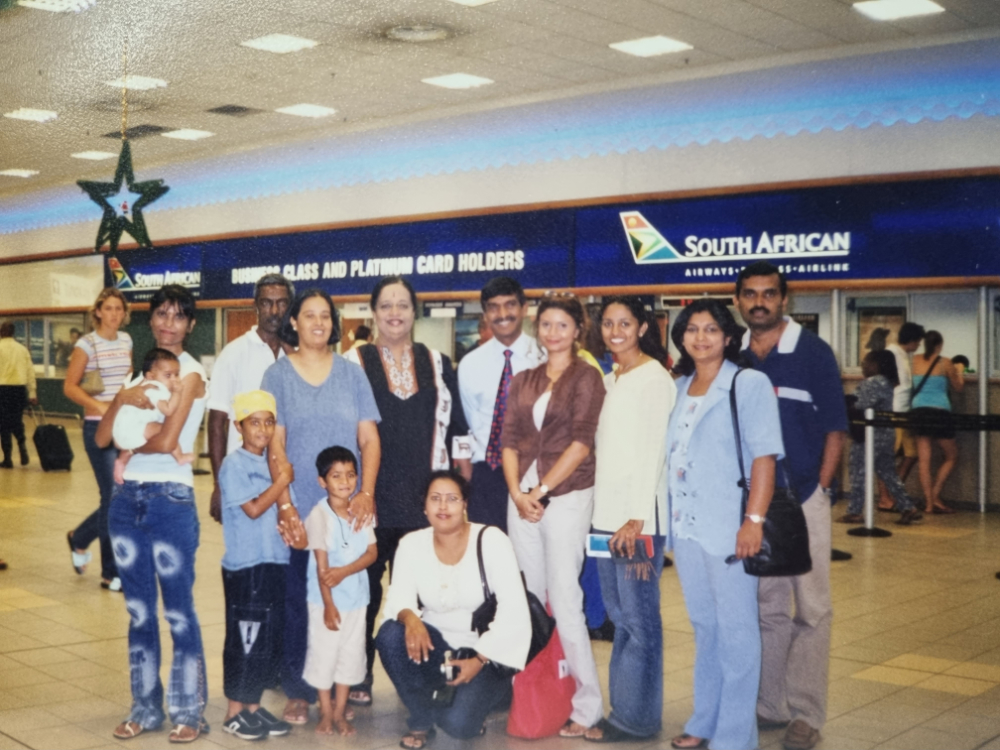
This month, Vijaya Nadesan, Academy Principal shares memories from 2002 of a trip to Durban by seven members of the Apsaras Dance Company led by co-founder Neila Sathyalingam. “The first stop was the wide stretch of the beautiful beach. We had a wonderful time strolling along the warm waters of the Indian Ocean. It was later that we came to find out that the beach was one of the Golden Mile stretch of beautiful beaches that are separated by piers and offers a great scenic view of the Indian ocean. It gave us a breath-taking view. The next morning, we were busy preparing for a performance in one of their temples. Our final performance was for the closing ceremony of the Tamil Language Conference. As we ended our last item, we had a standing ovation and the atmosphere in the function room filled our hearts with great joy. It was indeed a memorable trip of my life.”Read more Durban Trip Walking down the memory lane, to the time I was in Durban, I must admit that it was one of the most memorable trip I had in my life. We had many interesting experiences in a city that is famous for its idyllic beaches and scenic mountains.It was the year 2002, the Durban Tamil society was hosting the annual Tamil Language conference in its city and we were invited by our Singapore Tamil Society to perform in Durban. When Maami told us about the 10 days trip, my heart did a backflip in anticipation as I was unsure how this trip was going to be as we have not travelled that far. But I believe we made the right decision, as I will never forget the hospitality of the strong Indian community who welcomed us whole heartedly and made us feel at home.It was a very long and tiring trip of over 24 hrs journey with two stop overs. Our Singapore delegates consisting of seven Apsaras Arts Dance members (including our beloved Neila Maami) and afew Tamil enthusiasts such as poets, writers and teachers from the Tamil society embarked on our journey with great excitement. As we stepped out of Durban’s King Shaka International Airport, I was tricked into thinking that I was in Europe or America. On the contrary we were immediately escorted out of the airport by very stern looking Security Officers with REAL Guns hidden in their Coat pockets. Later we were informed that though Durban looked very modern and safe, unfortunately, the crime rates aren’t low. That information did not deter our enthusiasm in roaming the city with the trusted security Officers. During the daytime, while the Tamil enthusiasts are busy attending the conference we were given a tour of the scenic Durban City. The first stop was definitely the wide stretch of the beautiful beach located near our 4-star hotel. We had a wonderful time strolling along the warm waters of the Indian Ocean. It was later that we came to find out that the beach was one of the Golden Mile stretch of beautiful beaches that are separated by piers and offers a great scenic view of the Indian ocean. It gave us a breathtaking view.The next day morning we were busy preparing for a performance in one of their temples. At this juncture I must admit that I admire our Neila Maami for her quick decision making attitude, as she always speculate her trip and is always equipped herself with her Plan B mode. As usual we prepared a full 20 minutes Margam for the crowd, as we thought that the temple goers are the ones watching the show. Adorned in our classical costumes and make up we arrived at Shree Siva Subramaniar Temple that night. We were thrilled to see a huge temple for Lord Muruga and came to find out that the prominent Indian residents of Durban have contributed to the erection of both the temple and hall next to it. As mentioned, our performance took place in that very hall that was built for social functions and celebrations. When we stepped into their dressing room, we realised that we were going to perform for the local Tamil society that has organised a community party in that very hall. Immediately, Maami went into her Plan B mode, in lightning speed she reacted to the situation and took out another cd from her bag that was filled with few of our semi classical and traditional dance sequences. After a quick discussion among we dancers, we went into our performance mode to performance those items in the classical dance costumes rather than the Margam. Nevertheless, we thoroughly enjoyed our Maami’s impromptu plan and the Tamil community enjoyed our dance items. Praises were pouring in after our performance and we were ushered into the dining hall that served non-vegetarian meal in the temple ground. To our surprise they also made sure that we don’t leave without partaking in a good meal with them that comes with lots of laughter and warmth. It was a crazy night for us to forget. Our next performance was for the closing ceremony of the Tamil Language Conference. By then most of the conference crowd knew who we were as we have also conducted a Dance demonstration on Bharathanatyam and other classical dance forms for one of their conference talks and for their Tamil Medium School. This time with no change in plans, we were pleased to perform the prepared classical dance items with no hiccups. The members of the conference and notable Durban Tamil leaders were present for the ceremony, the show went off superbly well and all of us gave the best of our energy in showcasing those items. As we ended our last item, we had a standing ovation and the atmosphere in the function room filled our hearts with great joy. It was indeed a memorable trip of my life.
Arohana – Kathak Manch Pravesh by Sindhu Achudan
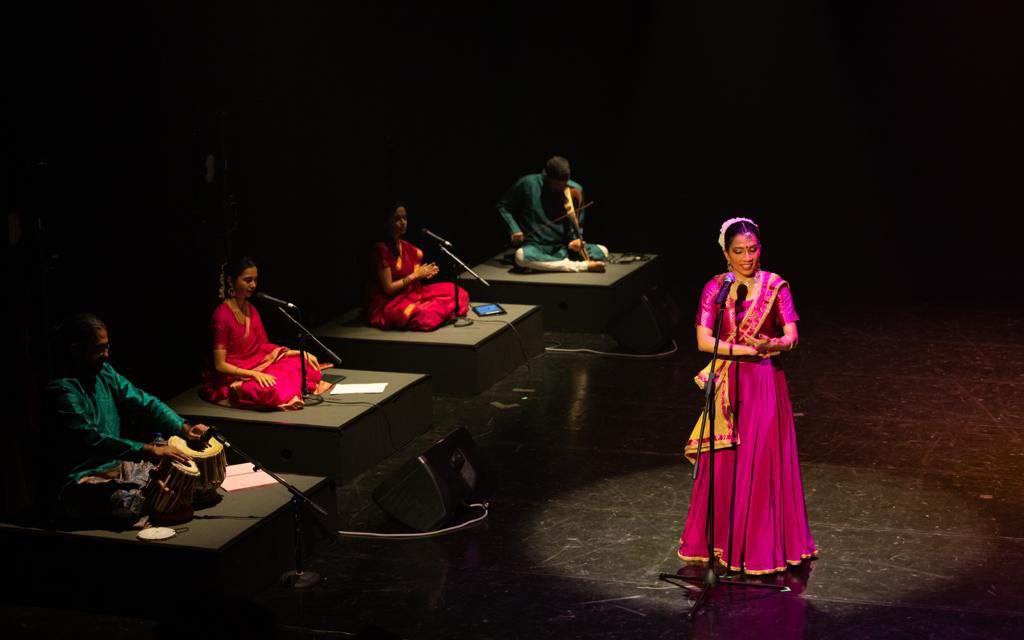
By Nayantara Parpia On Sunday, 25th April, a few of us in Singapore had the privilege of attending a very special dance recital, ‘Arohana’ – the Kathak Manch Pravesh of the young and multi-talented Sindhu Achudan, at the Goodman Arts Centre Black Box. Congratulations to the entire team at Apsaras Arts and my dear friend Shivangi for achieving this huge milestone. May there be many more such gems to emerge from the institute! My heart-felt wishes to the young star of the show, Sindhu Achudan, and her supportive family.” On Sunday, 25th April, a few of us in Singapore had the privilege of attending a very special dance recital, ‘Arohana’ – the Kathak Manch Pravesh of the young and multi-talented Sindhu Achudan, at the Goodman Arts Centre Black Box. The stage was set in a traditional yet very striking way. On the right hand side was a beautifully decorated Nataraja statue, two glimmering brass diyas and photos of the late founders of Apsaras Arts, Shri S Sathyalingam and Smt Neila Sathyalingam. And on the left hand side, the accompanying musicians were grandly seated on separate pedestals, their artistic auras further illuminated by individual beams of ethereal light. On the backdrop was the projection of a temple archway, simple and beautiful, altogether creating a divine and inviting ambience for this intimate gathering. Sindhu, dressed in a beautiful fuschia lehenga, commenced her recital with a Dhrupad, invoking the Lord of dance himself. “Shiva Shiva Shiva….. Shankara Adideva, Shambhu Bholanath, Yogi Mahadeva…” Set to Sool Taal and Raag Adana, this Dhrupad was popularized by the iconic Dhrupad vocalist duo, the Gundecha Brothers. True to the powerful music composition, the piece was choreographed by Shivangi with strong, statuesque stances depicting Shiva in all His glory. The lyrical depiction was interspersed by short ‘Nritta’ segments, which Sindhu pulled off well for an impactful opening. It takes a dancer many years to develop the strength and focus required to embody Shiva, so one could see that Sindhu’s background in Bharatanatyam naturally helped her in this aspect, albeit through a new and different medium. As per the traditional repertoire, next was the Nritta showcase in Teentaal, a cycle of 16 beats. Sindhu began with ‘Vilambit laya’, the slow tempo of the Taal, with ‘thaat’ – where the dancer’s body slowly awakens to the beat of the Taal, flowing with the soothing lehra, highlighting the ‘sam’ or the first beat of each cycle, with a beautiful pose. There was also the traditional Aamad, Uthaan, Paranaamad and Tatkaar, gradually leading up to ‘Drut Laya’, the fast tempo of the taal, featuring both ‘Nritta’ and ‘Nritya’ components like Tukda, Tihai, Paran, Parmelu, Gat Nikas, Gat Bhav and Rela, many of which were carefully passed down by Shivangi’s gurus to her, and now to her disciples. It was wonderful to see Sindhu dance tirelessly, showcasing a wide range of technical compositions with graceful movements, rhythmic variations like ‘tishra jaati’, ‘padhant’ (recitation) and ‘bhaav’. The third piece for the evening was a ‘Thumri’ – “Kahe Karata Mose”, depicting the mischief of Lord Krishna teasing young Radha. A classic ‘bandish’, bringing out the beauty and subtlety of facial expressions in Kathak. Sindhu, with her youthful and vibrant face, portrayed the innocence of Radha very sweetly. She concluded her performance with a Tarana in the 10 beat time cycle Jhaptaal, set to Raag Darbari, a well-known musical composition by Pandit Birju Maharajji. Shivangi’s choreographies always carry a well-balanced sequence of ‘Tandav’ and ‘Lasya’ movements, in tune with the musicality of each composition. Sindhu appeared for the last presentation, dressed in a very pretty peach Anarkali, the other costume style of Kathak, credited to its Islamic heritage – a perfect match for the ‘Darbari’ tarana. She moved with grace, confidence and a vivacious smile, reflective of the inner joy that comes only with hard work and perseverance. As Aravinth anna rightly quoted Neila mami, “The centre of gravity on a dancer’s stage is actually on the side, where the musicians are seated.” How wonderful it is to experience classical dance with Live musicians, something we see a little less of these days, due to budget and space constraints. But it is so important for teachers and dance schools to invest in live accompaniment, to cultivate that tradition in the next generation, and to give young dancers the experience of both the challenge as well as the collective energy of multiple artists creating art together on stage. Tabla artist Lalit Kumar Ganesh, vocalist Pratima Bellave Ganesh and violinist Bombay V Anand provided excellent accompaniment, bringing the dance performance alive. Often, during the recital, my gaze would shift to them, as I danced along in my seat! On a personal note, I have been associated with Apsaras Arts from Day 1 of the opening of its Kathak department with just one student, back in 2014. With the steady guidance of Shivangi Dake Robert, the Kathak team has come very far in just a few years. It fills me with pride to witness the school as well as the overall Kathak community in Singapore blossom more and more with each passing year. I must add that considering the climate in most parts of the world at the moment, with respect to Covid, I will admit that as residents of Singapore, just dressing up and having a live event to go to was in itself very special. Thanks to everyone who has worked so hard to give us fortunate few such a memorable evening. Congratulations to the entire team at Apsaras Arts and my dear friend Shivangi for achieving this huge milestone. May there be many more such gems to emerge from the institute! My heart-felt wishes to the young star of the show, Sindhu Achudan, and her supportive family. On behalf of everyone who was present or watching her virtually, I wish her all the very best for a long and joyous journey with Kathak and many more years of deeper exploration and artistic growth. By Nayantara
Indian Sun – The Life and Music of Ravi Shankar by Oliver Craske (2020)
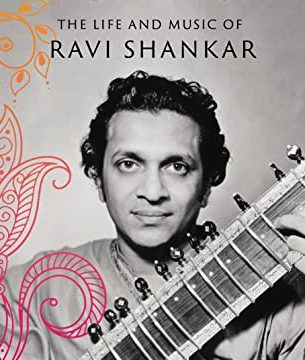
Indian Sun is the first biography of Ravi Shankar. Benefitting from unprecedented access to family archives, Oliver Craske paints a vivid picture of a captivating, restless workaholic, who lived a passionate and extraordinary life – from his childhood in his brother’s dance troupe, through intensive study of the sitar, to his revival of the national music scene; and from the 1950s, a pioneering international career that ultimately made his name synonymous with India. This was a profound read for me. Personally, I have learnt so much more about his life from this reading and the impact it had on many others. The complexities and challenges faced by him and others around him is worthy reflection. He also lived throughout the 20th century and was privy to much of how the world worked. This book illuminates the role and propagation of Indian classical music in the world and Ravi Shankar’s pivotal role in it. It’s a must read for any music lover. his passion for creativity, spirituality in sound, the art of collaboration and what it takes to be humble in your talent is well detailed. The book references many other Ravi Shankar resources for your further study of this man and his work. It’s a very touching and impactful biography of a great legendary artist who was also a flawed human being. I feel thoroughly enriched to experience his life through these words. This was a 5/5 read for me.
Agathi Review by Kids Beginners Year 2 class

Agathi – The Plight of the Refugee This show was a great experience and a great Learning. Artistic Director , Mr Aravinth Kumarasamy and Dramaturg Mr Ivan Heng did a great job. The Choreography was so nice, I wanted to watch the show again. Thanks to Choreographer Mr Mohanapriyan Thavarajah. I understood the story so well as the storyteller Ms Seema explained it clearly. All the dancers performed with confidence. This was an awesome show.Reviewed By Advitha Agathi – The Plight of the Refugee This was my first time coming to Wildrice Theatre. It was one of the best theatres I have been to. About the seating arrangement, it was quite odd as we were seated at the 3rd level, but I still enjoyed it. When the show started, I was happy as there were happy songs with nice family set up. Suddenly, the invasion took place. I became sad and when the tone grew darker, I almost cried as only the Lady (Teacher Seema) survived in her family. When she recalled it after many years about her husband Balan dying in the war and Baby Gayathri has reunited with , there was a feeling hope.I can’t imagine how much effort has gone in the facial expression as the performance was amazing. I truly enjoyed the performance and was very happy that I came with my class girls.Reviewed by Sahana Agathi – The Plight of the Refugee I really enjoyed the AGATHI performance. It was very meaningful and tells the story of many people who struggled in the past in Sri Lanka. I cannot imagine going through the struggles that they did. At first, I thought that the performance would be similar to the SITA performance but surprisingly, it was quite different. This was a true story about everyone’s struggles. Even though the SITA performance was sad, I think that this performance was even more upsetting as it is a true story. In my opinion, the saddest part of the performance was when one of the actors lost all her friends and family. At the end, when the mother reunited with the daughter, I thought it was one of the happier parts of the performance. Other than the story, I really liked the lighting. It added very positively to my experience. I also liked all the costumes as they were unique, unlike normal grand costumes we usually see on stage. They really suited the characters and the mood. I was also surprised by how fast they could change their costumes in between scenes! All the dancers could change their emotions amazingly fast too. When one of the actors shouted, I also got a fright. All the emotions felt so real. I was immersed in the story and felt like I was going through the experiences myself. From the view I was sitting at, everything looked so amazing. Overall, I really enjoyed both the performance and the experience at Funan Mall. I hope to go on more trips like this.Reviewed by Thanashree Darshini d/o Thamil Selvan Students of Kids Beginner Year 2 class in Wildrice Theatre
A dance tribute by one thousand Bharatnatyam dancers to the Lord of Dance
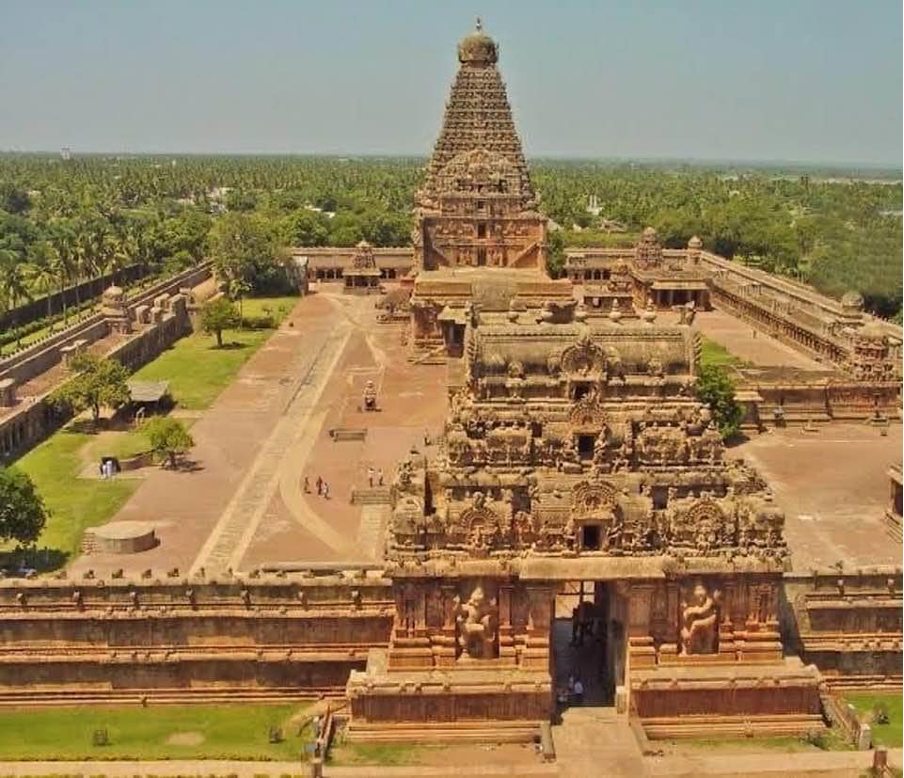
By Loganayagi Govindarajan Back in 2010 , Apsaras Arts was invited to participate in the celebration of Thanjavur Big Temple (Periya Kovil) for turning 1000 years old. The temple was called The Brihadeeswara temple in the town of Thanjavur, southwest of Chennai. This ancient temple was built by Raja Raja Chola in 1010 AD for Lord Shiva and has been recognised in UNESCO’s list of world heritage monuments. Joining dancers from various dance schools across India and the globe, Apsaras Arts company dancers from Singapore were blessed to part of the temple millennium celebrations. One might wonder how the planned performance was executed with 1000 dancers to commemorate the temple’s significance? All 1000 dancers did perform in unision to three Bharatanatyam numbers compiled, scored and choreographed by Padma Bhushan Dr. Padma Subramaniam, an eminent dancer and President of ABHAI (Association of Bharatanatyam Artistes of India) under the support of the state government of Tamil Nadu and the late Chief Minister, ‘Kalaignar’ M Karunanithi. I joined our Apsaras Arts team in September 2010 to honour Lord Shiva’s temple celebrations. We offered our beloved dance at the feet of our beloved dancing God. We danced to three dance numbers such as the Ganapati Kautuvam, Thiruvisaippa of Saint Karuvur Thevar, the spiritual Guru of the Chola King and Siva Panchakshara Sthuthi of Adi Shankaracharya. Personally for me, this occasion was also a kind of thanksgiving to the Chola history and rulers, the sacrifices and hard labour of so many strong man, artisans and elephants behind the construction of such a magnificent temple rich with indian architectures. The entire experience itself was not only spiritual but extremely special for any dancer. Similar to visiting a pilgrim site like Mecca, Jerusalem or Kailash, this was a pilgrimage for bharatanatyam dance communities at this holy temple ground to validate their dance dedication to Lord Shiva, our King of Dance. As a dancer, this trip helped me uncover my true purpose in dance. Apart from thanksgiving to the Lord of Dance, this was also an opportune to honour my Gurus who have imparted knowledge of this beautiful art form and shaped me into a fine dancer and educator today. My journey continues in touching lives with my Seva to God and my Gurus through dance.
An Interview with Dr Uma Rajan – accomplished dancer and arts administrator
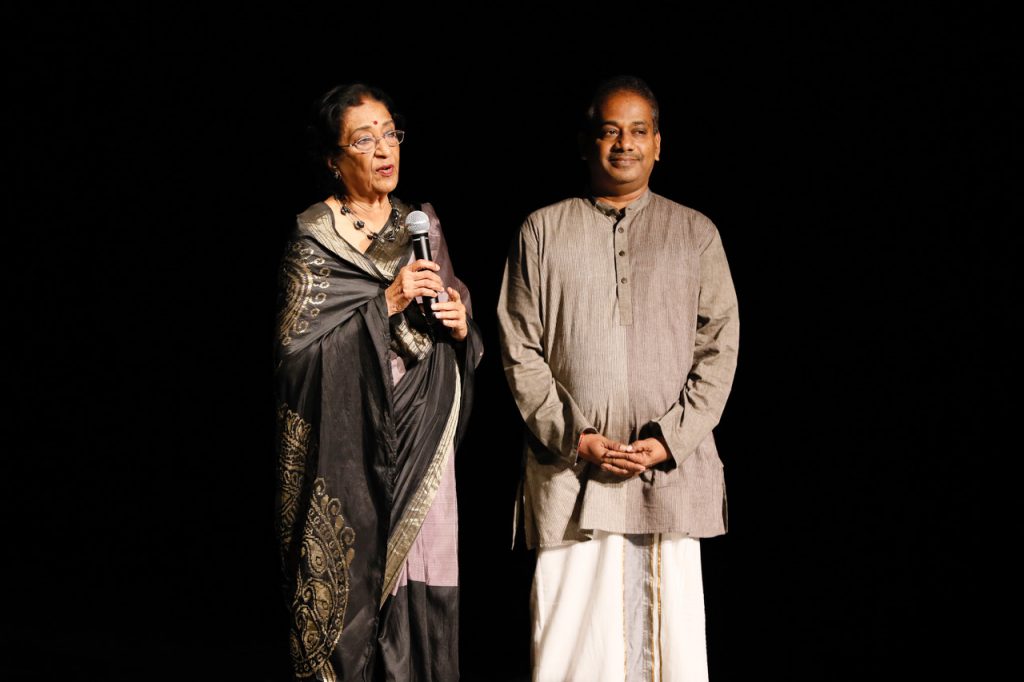
By Vidhya Nair VN: How did you come to be introduced to the Satyalingams & what were your first impressions? UR: I met them both soon after they arrived, probably 1974-5 at an Air India party (her husband Rajan was Reservations Manager with Air India at the time). Both Neila and Sathyalingam were of course much younger and my first impression of Neila was her open smile – halfway between a smile and a laugh. She was warm from the start. When she recognised that I was a student of Pandit Chokalingam Pillai (nephew and Guru of lineage of the legendary Pandanallur Meenakshi Sundaram Pillai), she made an instant connection with me. Satyalingam also remembered me from my Arangetram in Chennai back in 1954. It turned out that he was present at that recital. A lovely coincidence! I saw Neila as a typical Ceylonese-Indian family woman who spoke Tamil with the Ceylonese twang. Sathy (Satyalingam) at that time was a silent person, half-smiling and he would speak Tamil in the Indian way. We were in sync in every conversation and able to speak on many topics and have an opinion. We often talked about the arts and gelled on a big factor – her son, Skanda. I was Medical Director for School Health at the time and Skanda was a multi-disability child who needed total care and attention. Most importantly, I helped her write the first letter to MOM explaining the needs of the growing boy and his teacher-mother and why a male caregiver-helper was needed. I had tremendous respect for her in how she managed his care. Both Neila, Sathy and their daughters treated Skanda like a normal child and that was more than half the battle won. They needed a male caregiver for Skanda to move forward in their life in Singapore. After many queries from MOM, they received approval for a male caregiver from Srilanka, who was familiar with their needs and culture. Over the years each caregiver stayed for a number of years meeting the needs of Skanda and their home. It was then that Neila was able to free up her mind and channel her energy, talent, knowledge and skills to developing a new circle of artiste friends and make contributions to the arts scene in Singapore. We also gelled on the fact that my son, Sanjiv and Neila shared the same birthdate, – February 8th. My son and she would exchange annual birthday wishes and speak to each other on that date. She was terribly upset when I was widowed and we often reflected on our first meeting when she met Rajan. She had noticed then that I had placed a rose at the nape of my neck in my hair the same way she also did too. We clicked, not realising how close we had become over the years but that’s how it was – a strong emotional bond based on our shared love for Indian classical music and dance, the medical care of her son. Managing our family and home – for me, she was like my family! VN: How did your relationship with Neila evolve over the decades? Share your thoughts about how you saw her develop her art in Singapore? UR: Neila wanted to start giving dance classes. She had a special talent for teaching little children. She first started classes at Handy Road (behind Cathay Cinema). My daughter, Rekha joined along and so did a few other mothers who sent their daughters. My son would come along too. It was a very simple, single room with a stage. She taught basic Bharathanatyam for children and Sathy and daughter Mohana gave her the background music support. Over the years, my mother, Mrs Sharada Shankar an accomplished violinist, also came forward to join Sathy, Mohana and their troupe in their Carnatic music recitals at various venues in Singapore. The way Neila started in the arts scene was gradual, a step-by-step move up the ladder. She started classes at Cairnhill Community Centre and then at Tanglin Community Centre. I remember when the Minister for Law & Member of Parliament Mr E W Barker came for an event there to present certificates to performing children, he commended her on her work at Tanglin CC. It was a step into her future work with People’s Association. At Cairnhill CC, she moved towards inter-ethnic work collaborating with other leading dance veterans, Mdm Som Said and Mdm Yang Choong Lian. This resulted in the formation of Little Angels – a multiracial children’s dance troupe. Neila wanted the children to participate in a folk-dance competition in Europe and she needed help with the funding. I’ve always believed that it is easier to seek a small amount of funds from a larger number of donors than one large amount from a single donor or sponsor. I managed to help her achieve this and we sent them to Europe. They came back winners and that was a significant feather in her cap and inter-ethnic dance became her mainstay. This is an important criterion for the Cultural Medallion (highest culture award by National Arts Council which Neila Satyalingam received in 1989) She built a little fraternity there and also at the Kamala Club on Moulmein Road (near the Indian Association). She was appointed as People’s Association’s choreographer while based at Cairnhill CC and received much needed support from them. She had an innate talent to link the artforms and the ability to respect and get along with the other ethnic group champions. They were like sisters – not commonly seen. It was not competition at all. It was them, coming together, moving up hand in hand, benefitting each other so that none were left behind. Their contribution was in the right direction. When the National Arts Council was formed (in 1990), I was nominated to be a Council Member along with Prof Bernard Tan, Brother McNally. Mdm Kay Kuok. Mr Robert Lau and other leading community arts champions under the leadership
Radhika and Muddupalani Intertwined, Sthree and Churning Waters
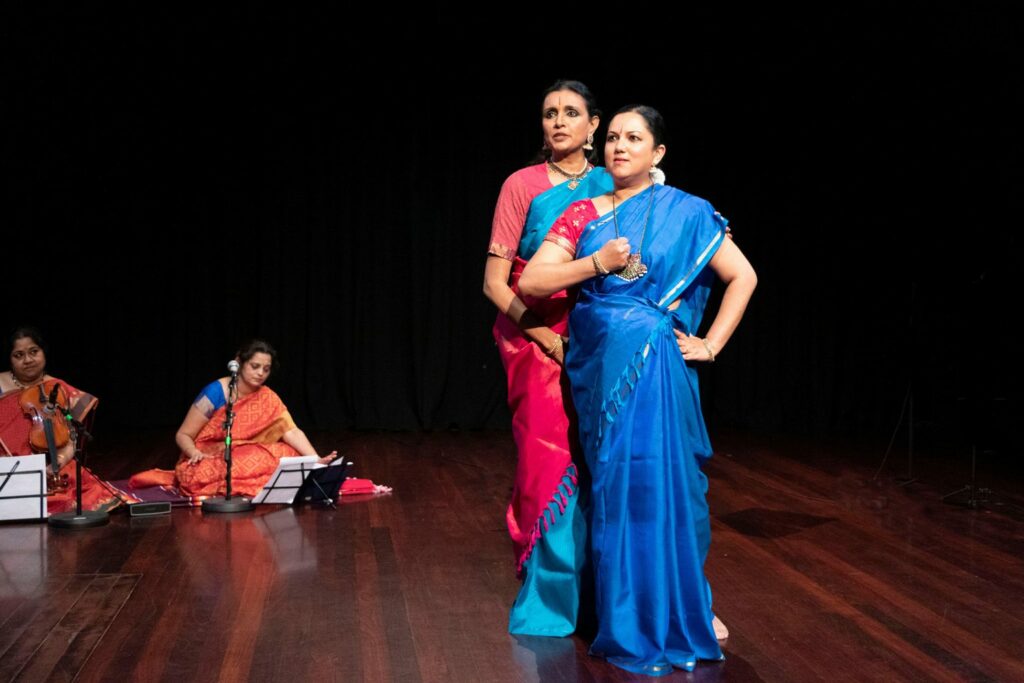
Priyadarsini Govind and Dr. Priya Srinivasan (A version of these articles were printed on The Hindu in 2020) Which other woman of my kind has felicitated scholars with such gifts and money?To which other women of my kind have epics been dedicated?Which other woman of my kind has won such acclaim in each of the arts?You are incomparable, Muddupalani, among your kind. In this three articles, Ms Priyadarsini Govind, a national and international award winning Bharatanatyam dancer and artist based in Chennai and Dr. Priya Srinivasan, a dancer/ scholar from Melbourne Australia discusses the inspiration behind their collaborative works that were staged in 2018-2019 as part of the Sangam, Performing Arts Festival of South Asia and Diaspora held at Dancehouse, Australia. The first article explores marginality in relation to patriarchy in the work of the acclaimed devadasi Muddupalani from the 18th century and how it informed their performance: “Radhika and Muddupalani.” The second article looks at violence against women stemming from sexual repression in Indian society due to the collusion of various forms of patriarchy in our intercultural project: “Sthree.” In the final article, the authors continue to explore questions of marginality from their perspectives through the intercultural work: “Churning Waters.” Through research and performance exchange the collaborators were able to find cultural differences and similarities including the idea that Indigenous Australians and Indians had been exchanging ideas for thousands of years evident in DNA, animals, coins, dances, songs and Dravidian languages present in Indigenous cultures. Read more… Article 1: Radhika and Muddupalani Intertwined Which other woman of my kind hasfelicitated scholars with such gifts and money?To which other women of my kind haveepics been dedicated?Which other woman of my kind haswon such acclaim in each of the arts?You are incomparable,Muddupalani, among your kind. So begins the Radhika Santwanamu an epic, erotic poem by the devadasi Muddupalani, who dared to write about female desire in the mid 18th century. We came across the “Radhika Santwanamu” by Muddupalani at different moments in time at different spaces across the globe but united by our need to understand how women have played with power and survived. PS: I came across it in 1996 in Los Angeles in a writing class as a fragment when Susie Tharu and K. Lalita published small sections in their larger work “Women Writing in India Part 1 and 2” and wrote that the devadasi Bangalore Nagarathnammal published the poem in full with the recovered coda (above) in 1910 that named Muddupalani as the rightful author of the work. The work was censured, banned and destroyed in 1911 by British colonial authorities who did not want to read women writing about their sexuality and desires. It was also in 1996 I encountered the hybrid and appropriated history of our form (in Avanthi Meduri’s unpublished dissertation) which stopped me from dancing Bharata Natyam publicly for the next 12 years in order to understand this complex history.I sat with the work for many decades wondering when and how it should be presented, under what circumstances and who had the right to present this work- in what form? As more and more sections began to be translated, we had the complete work in English by Sandhya Mulchandani in 2009. We began seeing how women’s bodies and voices continue to be silenced around the world I felt it was time to start to engage seriously with Muddupalani’s text because of its continued relevance in today’s world. PG: I came across it in the 1990s when V.A.K. Ranga Rao brought it to my attention as a unique piece of writing by a woman, a devadasi whose work had survived the test of time. I returned to it when Priya Srinivasan brought it to my attention. The complex characters in the poem: Radhika and Ila (two women) and their love for Krishna caught my imagination. A love triangle with a twist in that Radhika marries Krishna to her own niece, Ila in an effort to retain her hold over Krishna. It was interesting to interpret the multilayered character of Radha- by giving him away did she think she could keep him? But when things go beyond her control what is her reaction? What about the man’s role? Has society changed since then? Where does this inspiration for Muddupalani comes from? To what extent is it autobiographical? I was also curious about the reason it was banned as it was no more licentious than many other male poets. Perhaps the most powerful aspect of this work to me as an artist, is the concept of a woman revealing both her most vulnerable moments and her greatest strengths with equal candor and courage. PS and PG: Together we decided to rework the poem taking only small sections of it. The collaboration occurred between us (Priyadarsini Govind and Dr. Priya Srinivasan) with Uthra Vijay (carnatic singer / composer), Lalgudi Vijayalakshmi (violinist/composer), Ching Ching Ho (Director/ dramaturg) and Dr. Philipa Rothfield (philosopher and dance writer) in Melbourne in November 2019 as part of the Sangam: Performing Arts Festival of South Asia and Diaspora held at Dancehouse (the home of contemporary dance in Australia). Using performative methods of Carnatic music, Bharata Natyam, spoken word and literary readings, our intention was to represent the devadasi Muddupalani and the characters in the Radhika Santwanamu but to analyse the 18th century text from our perspective as 21st century artists. Fragments of the history reveal that Muddupalani was a consort in the court of the Thanjavur ruler King Pratap Singh. Increasing evidence also suggests that her grandmother (not by blood) the great devadasi Tanjanayaki was also his consort. This is a history of women who have no claim on the King and therefore had to negotiate power accordingly. Muddupalani’s work was being written during the transformation of the East India company from a trading company into a military power and King Pratap Singh was negotiating his own power. All this gives the composition and the author a unique place and voice in history. How she deals
Apsaras Arts hosts a book launch on “Temple Dance of Apsaras: A Dancer’s View of the Angkor Wat” authored by Mohanapriyan Thavarajah

By Meenakshi Palaniappan “I’ve always seen my role in the world of Bharatanatyam as that of the ‘Rasika’, and this book is an especial treat for me. After all, I’ve watched lovely productions by Apsaras Arts surrounding Angkor Wat, loving every one of them – Glimpses of Angkor, Angkor- the Untold Story, Anjasa and most recently their virtual production, Amara, based on the bas relief of Banteay Srei. Then, I’ve travelled to Angkor Wat as a university student and marveled at the beauty of the place itself, quietly wandering along the corridors of time in the majestic temple. Finally, above all, I am a Literature student at heart, and books are always my refuge. Mohanapriyan Thavarajah’s book, about a dancer’s journey exploring Angkor Wat, gives me the opportunity to marvel at the timeless in a time of intense change, and I can’t wait to delve right into it,” says Meenakshi Palaniappan regarding the book launch event held on May 14th 2021 at the Asian Civilisation Museum. Read More… It was a lovely evening to celebrate art and its posterity, in a time of change and uncertainty. Just that afternoon a slew of new guidelines had been announced, requiring us to keep our distance from one another. It was a balm to sit in the auditorium of the Asian Civilisations Museum to witness the launch of a book that sought to close the distance instead, across cultures, space and time. Indeed, as the world reels from the relentless onslaught of a germ, it is precious relief to disappear into the world of architecture and dance, brought to the fore through words and photography, truly no mean effort by dancer-writer Mohanapriyan Thavarajah. The evening started with a short film relating a dancer’s journey to find out more about Khmer art and dance through the study of the amazing Angkor Wat. It was powerful to hear how the tides of time and art worked to get us to this point, to this lovely book. As I understand it, the journey began in 2013, when Priyan was involved in an Apsaras’ production based on the gorgeous sculptures of Angkor Wat. He was so fascinated he went on to do more research about the connections and pathways through history that led to the construction of this amazing temple and how it stands testimony to the culture and dance of the time. What struck me most about the book was the intricate tapestry woven through history, cultures, mythology, dance and sculpture. I’ve always seen my role in the world of Bharatanatyam as that of the ‘Rasika’, and this book is an especial treat for me. After all, I’ve watched lovely productions by Apsaras surrounding Angkor Wat, loving every one of them – Glimpses of Angkor, Angkor, the Untold Story, Anjasa and most recently their virtual production, Amara, based on the bas relief of Banteay Srei. Then, I’ve travelled to Angkor Wat as a university student and marveled at the beauty of the place itself, quietly wandering along the corridors of time in the majestic temple. Finally, above all, I am a Literature student at heart, and books are always my refuge. Priyan’s book, about a dancer’s journey exploring Angkor Wat, gives me the opportunity to marvel at the timeless in a time of intense change, and I can’t wait to delve right into it. The book launch event, held on May 14th 2021 at the Asian Civilisation Museum, opened with a welcome address by Ambassador Mr K Kesavapany, Chairman of Apsaras Arts, followed by the publisher’s address by Mr Aravinth Kumarasamy, Artistic Director of Apsaras Arts. Guest of Honour, Mr Kenny Ting, Director – Asian Civilisations Museum unveiled the book alongside the author, Thavarajah and publisher, Kumarasamy. The first signed copies of the book were presented to the special guests and partners, Dr Ma Swan Hoo, Board Member, Indian Heritage Centre; Mr Paul Tan, Deputy Director, National Arts Council, H.E Mr P Kumaran – High Commissioner of India to Singapore; Mr David Pandarakannu, Programmer, Esplanade Theatres on the Bay; Mr Rajesh Boddu, whose beautiful photographs are featured in this book. The event, moderated by Ms Seema Hari Kumar, Senior Company Dancer and faculty concluded with a vote of thanks by Ms Vidhya Nair, International Development Director.