Master of Arts: A Life in Dance

By Tulsi Badrinath Master of Arts: A Life in Dance Male dancers provoke extreme reactions-Who wants to watch hairy sweaty men dance half-naked? or Oh, they are so effeminate. Must be gay! or They would not find a job anywhere, thats why they have come to this field. The author, who learnt dance at a very young age, could never reconcile this prejudice with the dignified image of her handsome guru Dhananjayan, recognized as a manly and powerful Bharatanatyam dancer. Curious about the boys from low-income families who followed their heart and dedicated themselves to dance, in a field where money and fame are not always guaranteed, the author presents their struggles to make their mark in this field. Weaving the story around her guru, and recounting the romantic story of how Dhananjayan met his wife Shanta, it considers whether his success depended on his being one half of a dancing couple. It also narrates the stories of many other male dancers like Navtej, Satyajit Dhananjayan and Anand, each of whom brought their unique perspective to this dance. About the Author: Tulsi Badrinath After acquiring a BA in English Literature from Stella Maris College, Madras, Tulsi Badrinath graduated with an MBA from Ohio University, USA. Returning to India, she worked for four dreary years at Standard Chartered Bank before quitting her job to pursue her twin passions – writing and dance. Her background in management helps her provide corporate executives with cross-cultural insights while interacting with them through the medium of dance. She is the author of two works of fiction, Man of a Thousand Chances and Meeting Lives.
Remembering Rukmini Devi Festival 2020
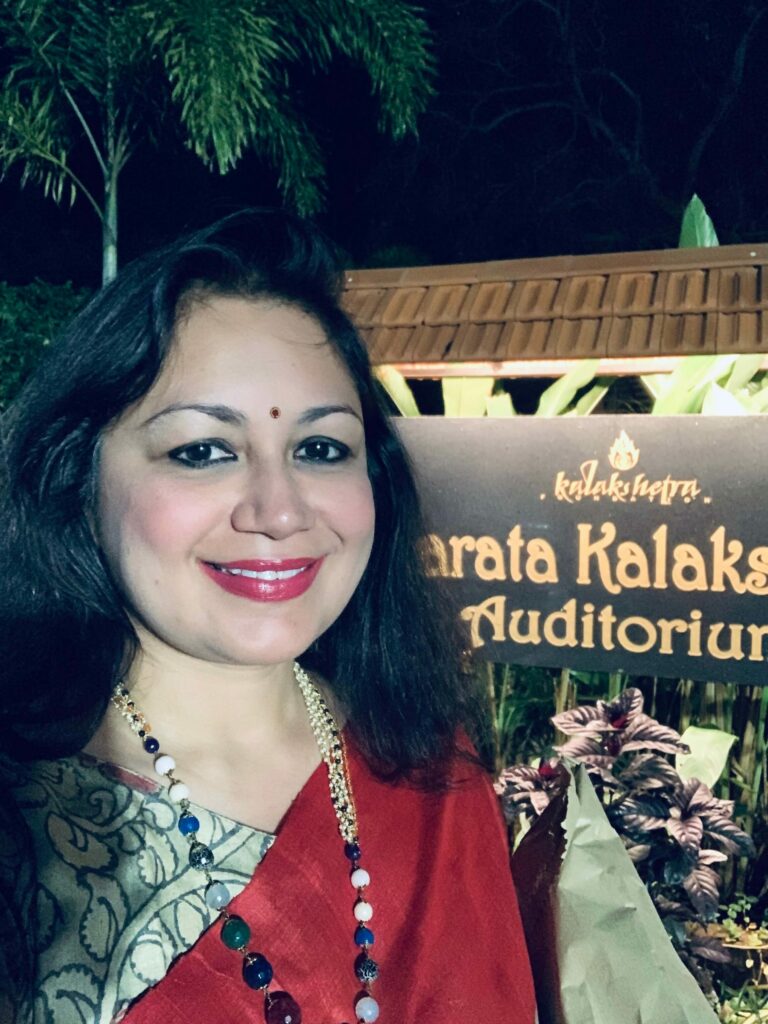
By Vidhya Nair The annual Remembering Rukmini Devi Festival is held in the last week of February-early March to coincide with Smt Rukmini Devi’s birth anniversary which is February 29th. I was privileged to attend the festival in 2020 [ my last trip overseas before the pandemic hit!]. The ambience at Kalakshetra at this time of year is unique, the weather is still cool and pleasant and unlike the Margazhi season, you get to meet and engage with many Chennai residents especially the young students and industry stalwarts. There was an eclectic programming of both music kutcheris in Hindustani and Carnatic featuring Ustad Amjad Ali Khan and his sons and Sanjay Subramaniam in concert. I attended the latter to get the experience of watching this vocalist with a strong following and fanbase. It was a packed auditorium and many students took their place on the stage where he delivered, with his excellent team of musicians, rare Tamil krithis which enthralled the audience. Many were familiar with the compositions and joined in putting talam or had their eyes closed in reverence to the music. Sanjay was a tour-de force performer with his masculine voice and command of the stage. I understood fully why he had so many fans. There was also a very engaging Villapattu performance as part of the opening ceremony in the morning. Beautifully spoken Tamil and the tongue-in-cheek humour was memorable and play on Rukmini Devi’s name and attributes were cleverly done. The other highlight show I witnessed was a ” presented by Sheejith Krishna, P T Narendran, Shijit & Parvathy Nambiar along with the Sahardaya Repertory. The attendance for this show featured all the who’s-who of Bharatanatyam from the Dhanajayans to Malavika Sarukkai, to Mythili Prakash. It was an electric performance which featured many of the signature poses, expressions and characters well associated with each of the dancers now household names themselves. There were ecstatic howls and screams of joys by many of the youngsters who sat at the front of stage and gallery upstairs. It was clear this was home turf and with the brilliant live musicians, you felt transfixed. An experience only possible at the Rukmini Arangam. Several nights also featured the Kalakshetra classics with episodes from the Ramayana presented in dance-drama. The space has a divine energy that transports you into the magical world of storytelling in its purest form and despite the large crowds that filled the Arangam, the easy chairs and high ceiling ventilation supports a relaxing and engaging evening. I also enjoyed the simple canteen food and the shop which featured their handmade Kalamkari collection, traditional dance sarees and a wonderful array of Kalakshetra publications. I left with a few copies of books by Rukmini Devi herself and other writings on the history of this famed institute.
About Exposure, Experience and Experimentation: Interview with Monica Sharma Menon and Dayanand Menon
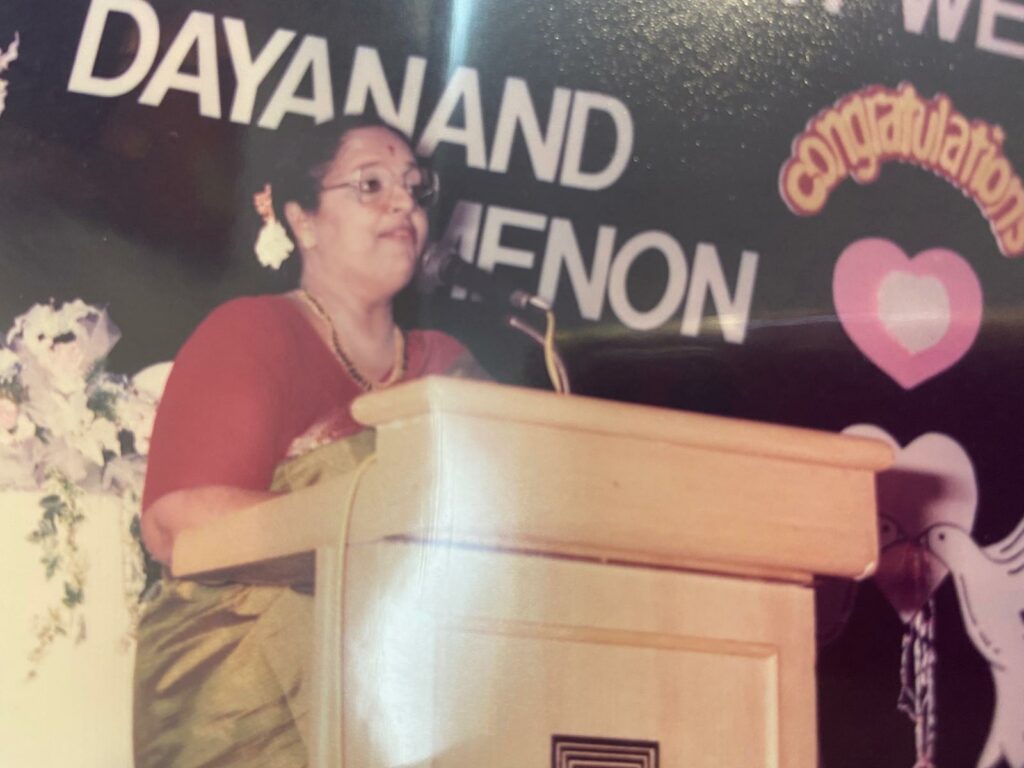
By Vidhya Nair VN: Tell us about your background individually and together? MSM: I’m a 3rd Generation Singaporean of Punjabi descent. I have a younger sister who’s married and settled in Sri Lanka and my mother’s extended family still live in Medan, Sumatra where my mother is from. Dayanand is from a Malayalee-Menon family. As Singaporean Indians, I see that we have a shared history so even the diversity in our cultural nuances is easily accessed. My father was always interested in the arts and culture since he was young. My paternal grandfather was close friends with Dr Chotta Singh [ medical doctor and founder of the Ramakrishna Sangeeta Sabha – the first Indian Orchestra of Singapore] who ran a small clinic in Serangoon Road. Coincidentally, he was also known to the Menon doctors who ran Lily Dispensary & Clinic [ incidentally part of Dayanand’s extended maternal family]. My father used to perform with the Indian Music Party singing Hindi songs at Malay and Indian weddings in the late 1950s. He was also part of the Singapore Indian Film Arts and Dramatic Society and in 1964 was one of the judges for the saree queen contest which took place at the then brand-new National Theatre. [ Located on the slope of Fort Canning Park and River Valley, this was the first and largest theatre built in 1963 and demolished in 1986 to make way for building part of an expressway] DM: My parents came from Kerala. Mother from Palghat* and father from Thrissur. It was just me and my elder brother. In Singapore, I was born in the Moulmein Rise area and subsequently lived in Whampoa Drive from 1973-74, a few blocks away from Monica but we never knew each other then. The Whampoa Canal divided our area. We lived a simple life, no luxuries and went to neighbourhood schools. My father worked with the Royal British Airforce and my mother was a homemaker. It was a traditional Malayalee home but we brothers spoke in English. In retrospect, our family setup lent itself to us growing up with mastery in the English language although we lost out culturally as compared to our contemporaries. My parents were generally introverts and I only learned more about Amma’s early life post her death in 2015 where I was told that she was a vibrant youngster and extremely talented. Following her father’s lineage, she was often involved in theatre and performed on stage in her younger days. My parents weren’t active in the community and were relatively unknown but we were happy as private people. I was part of my primary school band, had an ear for music but I could never read the score. I think I was artistically inclined and took part in school plays but it was not nurtured or encouraged at home. I later trained to be a teacher then went on and studied in Canada. Upon my return I started with some relief teaching, which is how I met Monica at Towner Primary school. Later, I worked in the Big 4 Audit firms and today, I run my own accounting practice. * Dayanand’s maternal grandfather – K P Apukuttan Menon lived in Singapore from the early 1920s and worked as a court interpreter during British rule, raising his 5 children here before returning to Palghat, Kerala. He was a performing member of Dr Chotta Singh’s Ramakrishna Sangeeta Sabha orchestra playing the jalatarang in 1940 and was the founding President of Indian Fine Arts Society (later SIFAS) in 1949 serving 2 terms. When K P Bhaskar arrived in Singapore from Ceylon in 1952, it was K P A Menon who met him at the docks and arranged for him to teach dance to students at Kamala Club while he was in transit to go onward to Australia. This connection was made by K P A Menon’s elder brother K P Keshava Menon who was the High Commissioner of India to Ceylon and had met K P Bhaskar and helped him with his Australian visa. K P Bhaskar eventually stayed on in Singapore and formed Bhaskar’s Academy in 1952. K P K Menon lived in Singapore from 1925-1948, practiced as a barrister & was involved in the early formation of the Indian National Army and was also incarcerated by the Japanese in Singapore. He returned as a nationalist war hero to India and continued to be editor of the Malayalam newspaper he founded, Mathurbhumi till his death. His only son, the last King of Palghat M S Varma lived in Singapore to be a centurion, left for Calicut at the age of 102 and died in his niece’s home in Calicut in 2015.] VN: Monica, how did you come to become Maami’s student? MSM: My father believed that having an extra activity outside school was essential and my sister and I came to be sent for Sunday dance classes in the recreation centre at Farrer Park with K P Bhaskar in the late 1970s. After two years, my father felt we was not progressing and transferred us to Kamala Club to learn under Madhavi Krishnan. However, she eventually relocated to Australia and we went in search of another teacher. My father had heard of Mrs Neila Sathyalingam sometime in 1978, and had gone to Tanglin CC to meet her. So, on advice from his friend, Mr Ramachandran, who a was a fellow vocal & percussion, my father then enrolled us at Kamala Club, where Neila Maami had moved and this was ideal as it was close to Whampoa Drive where we lived. I began learning from Maami from 1981 and was her student for almost 36 years till 2016 before she took ill. While I took short breaks, during exams and my wedding and childbirth etc, I always went back to her for classes after that. VN: Share with us the role Mami played in your lives? MSM: I’ve come up with 3Es that epitomises what Mami did. Exposure, Experience and Experimentation. Reflecting back,
Nritya Kalanjali – a Bharatanatyam Arangetram
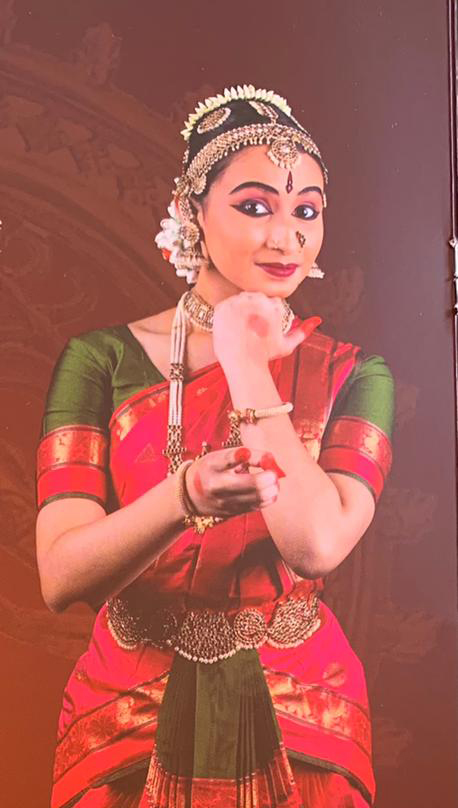
By Vaidehi Bodhankar Apsaras Arts was proud to present a live Bharatanatyam performance after a long spell in collaboration with Global Indian Cultural Centre (GICC) at the GIIS Auditorium on 27 June 2021. Vaidehi Bodhankar, 16 presented a unique repertoire which included 5 pieces in traditional original choreography. She performed the Keerthanam “Anandha Natamaaduvar Thillai” by Rukmini Devi Arundale and Abhang by Rama Vaidyanathan and Thillana by Kiran Subramanyam. Her teachers from Apsaras Arts include Seema Hari Kumar (this is her first student’s arangetram) Mohanapriyan Thavarajah and Gayathri Chachithanandar who ably taught and trained Vaidehi to deliver a self-assured and confident performance brimming with expressions and dance rigour. The arangetram was well attended by friends and well-wishers including Mr Edwin Tong, Minister for Culture, Community and Youth (MCCY), Member of Parliament for Pasir Ris- Punggol, Ms Yeo Wan Ling, Mr & Mrs Atul Temurnikar, Chairman and Co-founder of GIIS, Chairman of Apsaras Arts and GIIS Board Member, Ambassador K Kesavapany and Chairman of IAEC-Siglap South Community Centre Chairman, Dr Uma Rajan. Many guests remarked on the well-executed and organised program. A live audience also watched and give their feedback online. Aravinth Kumarasamy in his address mentioned the importance of the passing down of tradition and dance heritage through youngsters like Vaidehi and he acknowledged her bright future in learning and going beyond the first step she has just embarked with her milestone of an arangetram. Minister Edwin Tong also encouraged the learning of traditional arts and the vital role of culture in the betterment of our society.You can watch the performance here
A Quest for Dance – The Life and Times of Singapore Dance Pioneer K P Bhaskar
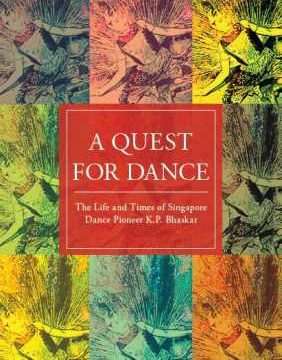
By Dr Wong Chee Meng, N Nedumaran This autobiography written in the voice of K P Bhaskar (1925-2013) and posthumously published in 2015 is an important read in the Indian performing arts space of Singapore. K P Bhaskar is the first Singaporean dance pioneer in modern Singapore and his contributions towards the propagation of dance outside of India is noteworthy. The book chronicles his early life in Kerala and how he came into contact with various dance forms especially Kerala Nadanam and Kathakali. His journey from Kerala to Madras to Bangalore to Ceylon and finally Singapore makes for riveting reading and provides historical context on the intertwined relationship between celluloid-dance-music which K P Bhaskar witnessed. He also names many individuals who helped and hindered him in his pursuit for dance and critiques his own community for their failings to support the arts magnanimously. The book should have had more photographs of his performances and greater insight on the continuation of his legacy and succession. There are many insights on his role and the Singapore approach to forge cultural identity through performing arts. The book raises important questions about the relationship between artistes, art companies, community and government. This is a must read for all Indian arts practitioners especially in Singapore.
NAVADISHA 2016

An opportunity to network with the Indian Dance Fraternity from the Northern Hemisphere By Aravinth Kumarasamy For the past two decades and more, I have been attending the Natya Kala Conference in Chennai, and a few other such international dance conferences in India and Singapore, in addition to the many ASEAN conferences in Thailand, Indonesia, Canbodia and Vietnam. It was a different experience to attend an Indian dance conference organised by a diaspora community in a western city – Birmingham, UK. The UK hosted a high-profile summit dedicated to Asian dance in May 2016, as one of the largest gatherings of artists, organisations, pundits, policymakers, funders and fans of dance from around the world gathered under one roof for Navadisha 2016. Produced by New Dimensions Arts Management in partnership with Sampad, Navadisha 2016 (meaning ‘new directions’ in Sanskrit) posed crucial questions designed to stimulate, steer and secure the future of British Asian dance as part of the UK’s ever growing dance landscape. It also celebrated many of the breakthrough achievements and exciting developments in and around the sector during the fifteen years since Sampad’s seminal conference Navadisha 2000, which helped to blaze a trail for a new generation of dancers and practitioners, sparking pivotal insights and actions across a variety of fronts, from artistic to organisational and political to structural. Navadisha 2016 attracted a line-up of 65 speakers, presenters and panellists from 25 cities in 12 countries and more than 150 registered delegates. It was a rare and valuable opportunity for dance practitioners, teachers, students, academics, agencies, programmers, venues, promoters, investors and policymakers across the arts sector. The three day programme covered a range of topics – from artist development to international collaboration, and contemporary factors that were shaping South Asian dance creation and distribution. It also highlighted models of excellence and innovation, and explored new ways of working. I was invited as guest presenter at the conference and had the opportunity to share about the work we have done inspired by South East Asian narratives. Apsaras Arts had an exhibition booth which attracted many delegates to come over and learn more about the Bharatanatyam based ensemble productions of Apsaras Arts Dance Company, Singapore. It was a great opportunity to network and meet up with many dance personalities from UK, Europe and USA in Birmingham. Though many of the presentations were UK centric and being practitioner of Indian classical dance based in Asia (Singapore), it was interesting to learn the term “South Asian Dance” being widely used at the conference by most speakers. It was also an eye-opener to see some of the contemporary works being experimented by UK based Indian dancers. The key-note speakers Shobhana Jayasingh, Akram Khan and Mavin Khoo raised a few thought provoking questions. Please see following links to read these keynote speeches presented at the conference Shobhana Jayasingh and Akram Khan I would say it was one of the most memorable dance conferences I have attended and many follow up conversations and collaborations were created at this event for Apsaras Arts.
Interview with Radha Vijayan – Driven by passion and devotion, a celebrated musician reflects on his life’s journey

By Vidhya Nair VN: Tell us about your family background – family members & growing up years in India? RV: I was born and raised in Chennai. Around the time of my birth, my father was already a well-known celluloid-film hero – Madras Kandaswami Radhakrishnan, known professionally as M K Radha. His father, my paternal grandfather who was a lawyer, Kandasamy Mudaliar was an avid theatre-maker and had ambitions for my father to be a leading actor. In the 1930s, he was one of the earliest theatre directors to present Shakespeare plays in Tamil. It was my grandfather’s script for “Sathi Leelavathi” [based on S S Vasan’s (who founded Gemini Studios) novel of the same name, also based on an English novel] which became my father’s debut film in 1936. The story explores themes of temperance, social reform, Gandhian concept of selfless service and the plight of labourers. The film was a hit and my father became an overnight star and he remained so for the next twenty years resulting in him receiving the Padma Shri in 1973 and a colony in Teynampet, Chennai named “M K Radha Nagar” in his honour. Incidentally, my father’s debut film was also the debut of M G Ramachandran (MGR) who also went on to become a leading actor and politician recognised and highly regarded around the world. They belonged to the same theatre group – MGR, his brother, M G Chakrapani, my father so it was like a family. Many of the actors of that generation came to be known in my home as members of our own family – we called them Chittappa & Mama. MGR Chittappa, Shivaji Chittappa, NS Krishnan Mama, Thangavelu Mama, Balaiya Mama was how I would address them. A well-known film my father acted in was “Apoorva Sagodharargal”in 1949 where he played the double role of look-alike brothers produced at Gemini Studios in Tamil, Telegu and Hindi simultaneously which had Nagendra Rao as the villain and P Bhanumathi as the female lead, who also sang most of the songs. The two brothers my father played in the film were Vikramasimhan & Vijayasimhan. I was born during the making of this film, that’s how I came to be named Vijayan after this film character and professionally, I came to be known as Radha Vijayan. I was the youngest of 8 children and 1957 when my father had a heart-attack and it became difficult for him to continue acting. My late eldest brother, an engineer became the backbone of the family and helped raise us all. One of my sister’s married film actress, M S Santanalakshmi’s son, M D Seetaraman and another sister married E V Saroja’s brother, E V Rajan, film producer. Some of my siblings has passed and rest are based in Chennai. I myself married Usha, daughter of Karukurachi P Arunachalam – famed Nadaswaram [ acclaimed for the timeless classic “Singara Vellan” track, a breakthrough hit for S Janaki in the 1962 film “Konjum Salangai”]. I have only one daughter, Abhirami. and I have a grandson, Aryan who is now a 10th grader. VN: Tell us about your learning experiences with music in your younger days? RV: From a very young age, I had a great passion for music. As a child, when I would go with my father for his film shootings, the moment I saw the assembled orchestra, I would be seated with all the musicians, watching them intently. I was a self-taught guitarist, by listening I came to imbibe the melody and techniques. There was not much encouragement from my mother’s side because they were familiar with the film and music industry. If there was a recording, you had wages otherwise nothing. Guitar unlike today was not known widely in the 1960s when I was a youngster but Manikavinayagam, my cousin (son of Vazhuvoor Ramaiah Pillai – famed Nattuvanar and Bharatanatyam guru) had a very old hand-made guitar at home. I used to spend time after school at his home and he gave that guitar to me. I restituted that guitar – stringed it and practiced on it much to my mother’s unhappiness who was keen I focus on my academic studies. E V Saroja noted my playing and bought me my first electric guitar. I learned both Western & Carnatic tunes by listening. The lyrics didn’t matter and I practiced regularly. Then it came to a standstill as I didn’t have a teacher but many who heard me felt I had potential. It was a friend, Krishna who recommended me to Dhanraj Master who accepted me earnestly as knew my father who was the star of that film, Chandralekha (1948) where Dhanraj Master had performed for the soundtrack of the film, This was a historical period film, then the most expensive film of its time, distributed internationally and today considered an Indian classic. I was 12 when I started learning with him and at 13, I performed my first concert in school. He would get me to write out notations, taught theory and I also picked up skills in piano as well which aided my keyboard playing later. It was at this time I met my best friend, Sadanandan who became the lead guitarist for Iliyaraja. We used to practice for hours together, often the guitar pieces of S Philip, the leading guitarist in filmdom and I dreamed of meeting and playing with him. I was able to achieve this dream finally in the 1980s. I also completed my classical guitar studies from Trinity College of Music, London and Indian Classical music under Karnataka Vainika Gana Vidyalaya and my interests broadened to include rock, pop, blues, country, jazz and fusion music. As I was a gold medallist in my degree program, I was easily recruited by a leading petrochemical company, music became a part-time activity. In 1965, I got to perform guitar in my first recording for a theatrical film. VN: You began to work with Indian music directors from the 1960s onwards. Share with us
NRUTHYA KARANA: A salient feature of any theatrical presentation

By Naatyaachaarya V.P.Dhananjayan A lesser known treatise on Naatya is Nandikeswara’s BHARATAARNAVA. Another work Abhinaya Darpana is also attributed to Nandikeswwara – a practical theory text in vogue, taught and applied in today’s Bharatanaatyam . As you all probably know, the theoretical application of Nandikeswara’s Abhinayadarpana started with the establishment of Kalakshetra, where Naatya Saastra and Abinayadarpana became an integral part of curriculum . Now of course every school of Bharatanaatyam makes it a point to teach Abhinayadarpana to an extent , if not Naatya saastra. All serious students of Naatya, with professional interest pursue the study of all theoretical aspects of Naatya and several of them have done research and obtained Phd-Doctorate in Natya theory. Though knowingly or unknowingly Bharatanaatyam practitioners use certain appropriate Karanas for delineating Abhinaya or emotions. AS you all probably know Bharata’s Naatya sastra is the ultimate reference treatise for all performing art forms including stage dramas like Kalidasa’s Shakunthalam, and the later editions of texts are mainly based on the mother book, more or less an extension of the main text. In Naaryasastra the main thrust is on the 108 Karanas , with categorisation of Nritta karana (for dance in general) yuddha Karana ( combat postures & movements) and niyuddha Karana (acrobatics like in Kalarippayattu , Tai Chi, Karate etc)(NS SAYS : hasta pada samaayuktho Nruttasya karanam bhaveit — a combined movement of hands and feet is nruttakarana. “Nrutei yuddhai niyuddheicha tathaa gati parikrame. karanani prayoktavyam – Karanas are used in Nrutta, yuddha (war) and niyuddha (small combats) depiction in Naatya presentations. Coming to the Nrutyakarana or Abhinayakarana, which are more explicitly described in the Bharataarnava treatise let me throw little light on the subject. matter. Naatyasastra generally talks about the mandalas(postures) and movements for Abhinaya, but Nandikeswara in Bharataarnava expounds further with details for each and every gesture and emotions.Abhinaya means -carrying forward-that is, communicating the meaning of the poem or song consisting of meaningful words. Instead of simply emoting through the face — known as ‘uttamaangaabhinaya- combining certain postures ,positions and movements, accentuate the actual communicative aspects. For example, the movements of Fish, or bee or butterfly or river Or samudra etc could easily communicate the object even to a lay audience. In common parlance Bharatanaatyam artistes and their Rasikas believe or are made to believe that “abhinaya” is only through face and total ‘Angika’ (consisting of) – anga prathyanga , upaanga prayoga – usage of complete body language is not needed or essential for ‘bhaava prakatanam’. In the Sadir or Devadasi tradition they focused only on facial expressions and not incorporating the full Aangikaabhinaya or Naatyadharmi mode of communications or presentation. Following the Kathakali method and finding the roots from Treatise, Rukminidevi in Kalakshetra, in consultation with scholars, reintroduced the Nrutya karanas or Abhinava karanas while delineating or interpreting ‘padaarthaabhinaya(word meaning) and vaakyaarthaabhinaya (a spoken sentence). Bharataarnava prescribes Mandala staanas (positions) and Abhinaya karanas for each and every ‘hastha’ & mudra. A physical demonstration would make it more clear to the onlookers. It is apparent that we need to renegotiate structures in our personal and professional lives to make sense of a post-COVID-19 world. The challenge to transform demands holistic action from us – as people and as artistes and, in this article, I look at the world of dance in particular. All said and done Bharata being a visionary has envisaged evolutionary changes and creativity in the generations to come (Bhavishyatascha lokascha sarvakarmanusaadhakam) .Bharatarnava further suggests Abhinaya karanas for objects with no sentiments or emotions like ‘sthavara’ ( tree, mountain, river, ocean, ball ,vessel, cart etc) and ‘jangamas’ like all kinds of animals and objects with life. Naatya saastra elucidate“ Aakritya cheshtaya chinnai jatyaa vignaya vasthuta haSwayam vitarkya karthavyam hastaabhinayam budhaihi” Meaning: According to the form, behaviour, categories (animal or human or objects) intellectuals could create their own mudras and abhinaya karanas. Movements in rhythm of animals such as elephant, horse , monkey, tiger, lion, ball game, Birds, spiders, wolves , jellyfish, submarines , rockets etc can be effectively portrayed with the help of Nrutya karanas. We can also show cricket or any other games, Flying, Etc in naatya. So the saastra has given us liberty to create and expound according to necessity . As the saying goes, necessity is the mother of invention. So over the years creative artists have evolved new gestures, new karanas to suit the requirements of the changing time. Naatya Saastra or the science of dramatics consists of all aspects of aesthetic art forms including pure dance, expressional movements, Sangeetam or music, drama, architecture, sculptures, Yoga etc. So the word Naatya is a comprehensive term for all aspects of theatrical art forms. “Na tat silpam na tat janam, naasaa vidya na saakalaa, naasow yogo natat karma Naatyesmin ya na drishyatei” This verse from Bharata’s Naatya Saastrajustifies that “Naatya” is the most appropriate term to denote all our theatrical arts forms, classical dramas included. So naatya can be defined as a combination of Nrutta(pure dance movements in rhythm) , Nrutya ( nrutta and abhinaya combined) drama (story telling). Article by Naatyaachaarya V.P.Dhananjayan, Founder/President, Bharatakalanjali, Chennai.
Inauguration of AVAI at Apsaras Arts
On 10th July 2021, AVAI @ Apsaras Arts, a performance space for Indian Performing Arts in Singapore was inaugurated. When we scouted around for names for Apsaras Arts’ own performing venue – an idea that was born nearly five years ago and is finally finding fruition – we were keen for it to be a word that represented and celebrated the premise, intent, spirit and sanctity of the space. We were keen the word conveyed -in short – what it was meant to be but also was packed with meaning and has a sense of continuity. That’s how we located AVAI, a Tamil word that literally means congregation, gathering, coming together, assembly of scholars, poets, artists, thinkers, do-ers, and intellectuals, of people who shared similar interests, energies and are part of an experience, together. It is housed within the office of Apsaras Arts, at the Goodman Arts Centre, Singapore, our home-away-from-home for 11 years now. In its sanctum sanctorum – so to speak – that has been our studio, ideas and thoughts, ingenuity and imagination, energy and experience have birthed and been nurtured; dancers, musicians, scholars and poets from far and wide, from home, our home in India, and from foreign lands, have shared their arts, discussed their processes, found in it rigour and shared it with students and those waiting and willing to imbibe it all. Drawing its design inspiration from South East Asian elements and raising a toast to all things Indian in the world of the performing arts, AVAI is also an extension of the Apsaras personality. Like its name – short but full of character and meaning – AVAI is all things intimate. Loaded with state-of-the-art technology – both in terms of sound and lights – and with configurable seats – depending on the nature of the event. AVAI also arrives as a smart and spiffy answer to the post-pandemic world that finds its presence in a digital world; where performing arts are increasingly reaching audiences through online portals and platforms. With a dual identity – both offline and online – AVAIl also allows us the potential and possibility of not merely meeting and curating events, in real-time but also translating that experience, online, through the AVAI platform on www.apasarasarts.com We are excited about AVAI; all that it stands for; of connections, offline and online.
Thursday Talkies – @akumarasamy

“in conversation on anything and everything about dance” An Instagram bi-series which began in February 2021, on the first Thursday of the monthat 8pm SGT has taken the classical dance industry by storm. Moderated by Aravinth Kumarasamy and Seema Hari Kumar, each 30 minute session features a discussion topic on current trends and issues in dance. In February, they discussed the topic, ” Choreography and what it means today”. In March, they discussed the topic, ” Guru-shishya relationship.” In April, the topic was ” Price of Art – How much do you pay? where the session introduced guest speakers (& mystery guests!). Anil Srinivasan and Vidhya Nair shared their view points. In May, the topic was ” Professionalism vs Amatuerism in Dance – how do we draw the line & what are the experiences of performers and rasikas?. Guest speakers Mohanapriyan Thavarajah and Sreedevi Sivarajasingam shared their experience. In June, the topic was ” The big “A” – exploring the intent, benefit and relevance of an Arangetram.” The session explored clarifications on how the teacher, student and parents can align expectations while having a rewarding journey. The session had Gayatri Sriram and Shankar Kandasamy as guest speakers. In July, the topic ws ” The Place for a Male” in Bharatanatyam featuring two male dancers – Christoper Gurusamy and Parshwanath Upadhye who spoke passionately about challenges and advantages they fare in the industry and in choosing this profession. Each session garners more than 500 views and features live questions from a live audience and is recorded for delayed viewing. Many viewers have feedback that this style of informal discussion allows for different perspectives to be shared in a frank and informal manner and for many its been an interesting way to hear alternative views and unpack some of the grievances and concerns which are often unspoken. The next session will be on 5th August on Instagram @akumarasamy at 8pm SGT.