#iamayoungdancer

Inspired by our campaign, #iamayoungdancer that we began in 2019, we, at Apsaras Arts, have been keen to listen to the voices of young dancers from across the globe. In an attempt to allow them an opportunity to share their challenges and aspirations, and do that with a peer, our section #iamayoungdancer, that unfolds as a video conversation, will articulate some of the concerns and desires of young dancers from around the world. We kickstart this edition with a conversation between Singapore-based Periyachi Roshini and Australia-based Rukshikaa Elankumaran.
The Bookshelf

Books Banter “What can Henry David Thoreau teach me about dance, wonders New York-based dancer-choreographer and academic, Maya Kulkarni letting us foray into Thoreau’s writing and her own response to it “ I have been re-reading Henry David Thoreau’s works, the Walden Pond, an all-time American Classic, particularly The Winter Walk, he wrote in 1843. Thoreau’s writings have absolutely no connection to dance. I read it for the sheer poetry and the magical spell he weaves when he takes me on a cold New England morning through the frozen landscape of the woods in Massachusetts. All is still and cold. Now, what has this to do with dance? Nothing really. But I find Thoreau’s writings nourish my creative urge. First, the quest for getting to the essence of things through detailing the smallest, minutest event in the life of a forest: the journey of a fallen leaf, twisting and turning with the eddies of the Walden Pond is an event. The faint scratch marks in the soft snow are a testimony to the million tiny creatures, the slow drift of snow vapours that hug the tree stems, linger over leaves, wrap through the branches to meet the weak tops alight with gentle rays of the sun, is an event. This attention to slow progression teaches me how the turn of the head in dance, the tension in the averted neck, the rise and fall of a shoulder, is an event that will concretize a character, and enrich the visual poetry of the ‘told’ narrative. The details create word pictures that must carry the essence of things at their heart. There is an oppositional way to create meaning: stillness can be defined by movement. Pauses say much, that a flurry of fancy movements might fail to do. Thoreau’s Nature has a purpose, a mood, and character: the ‘forlorn’ call of the owl, the ‘cheerful’ chirping of small, winged creatures, the slow ‘ponderous’ slide of a worm on the leaf, the ‘lonely’ woods and the ‘stillness’ of snowclad dawn that awaits the ‘burning’ that is to come. I too have tried in my works to endow creatures with human character and vulnerabilities. My Adventures of the Naughty Bee depicts the flighty and mischievous bee; the peacock in another composition is a show-off, proud and slightly wicked. Reading of the Winter Walk inspires a mood narrative. Finally, there is the essence of things: I too look for a central idea with which to begin, thread, and end. Comparison with a literary genius such as Thoreau is unseemly, I admit, but can I not draw on the rich experience that comes from a deeper reading of his work? On Our Bookshelf On Our Bookshelf Karnataka’s Rich Heritage – Temple Sculptures & Dancing Apsaras:An Amalgam of Hindu Mythology, Natyasastra and Silpasastra 1st Edition by Lalit Chugh Amongst all Hindu sculptures, sculpture of Nataraja, the dancing Siva, is perhaps the most popular. Over years, scientists, philosophers, artistes, scholars, writers, art collectors, archaeologists, mythologists, have dabbled with its form, content, philosophy, making it their subject of research, writing and conversation. Karnataka, and its temple architecture tradition, have played a pioneering role in giving an artistic form to this convergence in its temple sculptures. Though this trend may have started earlier during 2nd and 3rd century CE, it is believed that it took center stage from the times of the Badami Chalukyas. Passing through various refinements between 5th and 10th centuries, it reached its peak with the Hoysala art. This book traces the history of temple sculpture evolution and development through the centuries by referring to the existing sculptural forms and the canonical literature that developed over time. In this book, Lalit Chugh, a post-graduate in Physics from Delhi University, who has been working on heritage preservation issues, sheds light on the convergence between Hindu mythology, Natya Sastra and Silpasastra.
De-Constructing Tryambakam
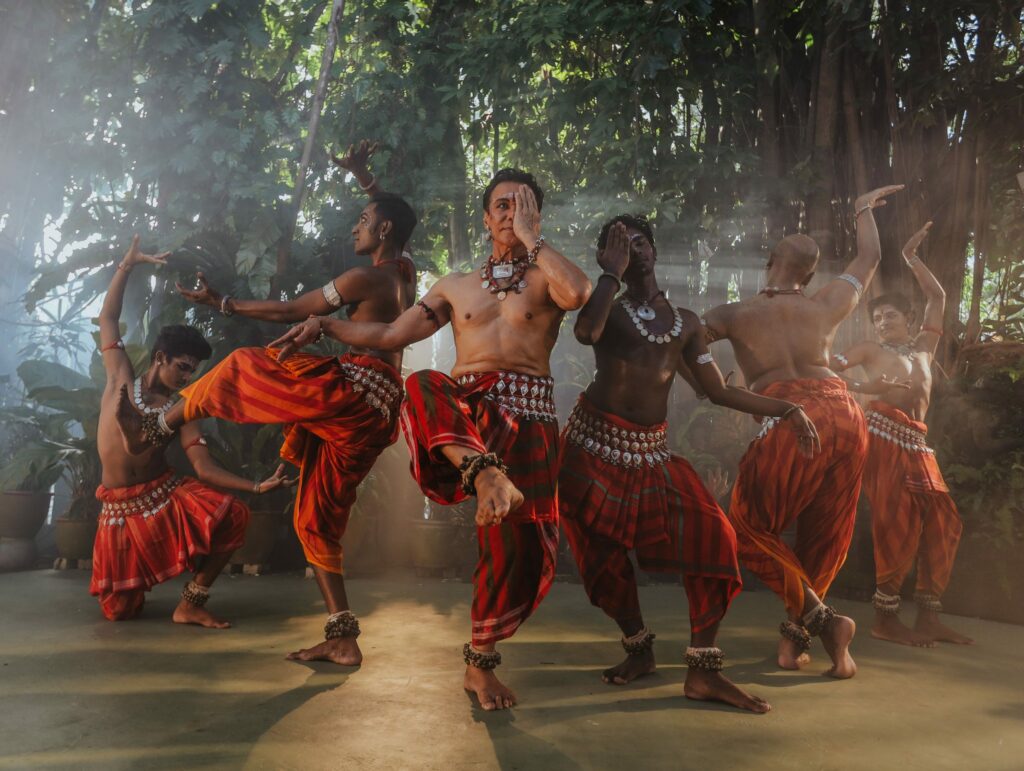
” Where Odissi exponent, Ramli Ibrahim, allows us insights into how Tryambakam was re-envisaged from a solo dance to an all-male group production for the camera “ Ramli ji, why did you feel the need to re-envisage a solo work like Tryambakam into a group work and also adapt it to film? Usually, we would learn the work in India as a solo item and then de-construct it for group work in Sutra. We often do this as we don’t have the luxury of giving the stage exclusively for a solo dance. There are just too many talented dancers in line, waiting to be used! Or the stage is often too big and rather ineffective for a solo dance! Tryambakam was taught to us by my guru-ben, Sujata Misra when we were in Bhubaneswar in 2018. It was one of the two dances by Sujata showcased in Triple Frontiers, an Odissi production that premiered in April 2021, just before our third lockdown. We decided to perform Tryambakam with an all-male cast as the work was essentially ‘tandav’. It so happened that I had a number of young male students from our Outreach program, whose combined talent was waiting to be shown. So, the work had to be ‘re-arranged’ for a group composition. Another opportunity arose to adapt it virtually on film with a relatively good budget. And so, Tryambakam went through several processes of ‘de-construction’. Fundamentally, the latter was inevitable as the work was no longer a solo item. And then, during filming, it had to be further re-envisaged to suit the demands of filming, group rearrangement, and location. What is the starting point when you have to de-construct an existing work? How much do you need to shed, and how much do you need to retain? Actually, in Tryambakam we retained all the dance vocabulary taught to us – we did not shed off any movement. However, we did add new image compositions and montages as sections of the alap were ‘empty’ and we couldn’t have a blank screen, the alap being an essential part of the music. There were also group sections which needed to be re-envisaged as we were no longer dealing with a lone body but several dancers. It would be so boring and unimaginative if the work had merely depicted six solo male dancers doing the same thing! What has it been like to envisage it for the camera? Some key learnings while doing so. We were lucky to find the right director, camera man, and also lighting director, who complimented one another! Eventually, it was the director who had to decide on the camera angles and direct how the footages should be edited. We also requested that some anecdotes and sections be layered or nuanced with allusions to the attributes of Lord Siva. One has to remember, that the filming was done during the lockdown, and this was the main reason we decided to use the premises of Sutra House for the location of all the footages of the six commissioned dance videos. Sivarajah Natarajan, who had been our lighting designer for almost 25 years, had to consolidate all the technical areas of camera, lighting, and sound so that they all contributed artistically towards the shared objective of the final film. We also had to sectionalise Tryambakam so that all areas of Sutra House were effectively utilised. The location is exquisite really; why is location particularly crucial while making dance on film? Sutra House has a wonderful ambience. During the several lockdowns, both Sivarajah and I had the time to concentrate on improving our premises and sprucing up the garden. There were several spots that were photogenic, especially in the early morning light, and these were used to maximum effect. Half of the battle is won when a compelling ambience is utilised with good lighting, natural or enhanced. I think a good ambience gives a scene that distinctive visual effect… The montage sequences at the beginning, were they constructed carefully? Both the montage and link sequences were carefully constructed to give that seamless and professional appeal. As mentioned, we had to augment the work with montages during the alap and this was done at back garden area of our studio. Filming is not physical theatre, and therefore the layering can be ‘artificially’, but artistically constructed. A lot, they say, happens at the editing table… you also played a lot with cool tones and an emphasis on contrasts; what was the thought behind that creative decision? There is only so much work you can do on editing – but if the content is uninteresting or not up to the mark, the final edit will still be poor. Having said that, there is much good contribution, an artistic director can do in the final touch-up, such as the suggestion of the kind of final tones and contrasts that the work should finally be given for that distinctive look. I guess in filming, the director and editor have the ultimate say in how the work will eventually look. The choreographer has to stand aside as ‘let his work go’ as the ball is no longer in his court. This is why I prefer the theatre, where the choreographer is still supreme, in control – and ‘what you see is what you get’, so to speak. This may not be so with filming.
Interview with Thiruchittampalam Ramanan
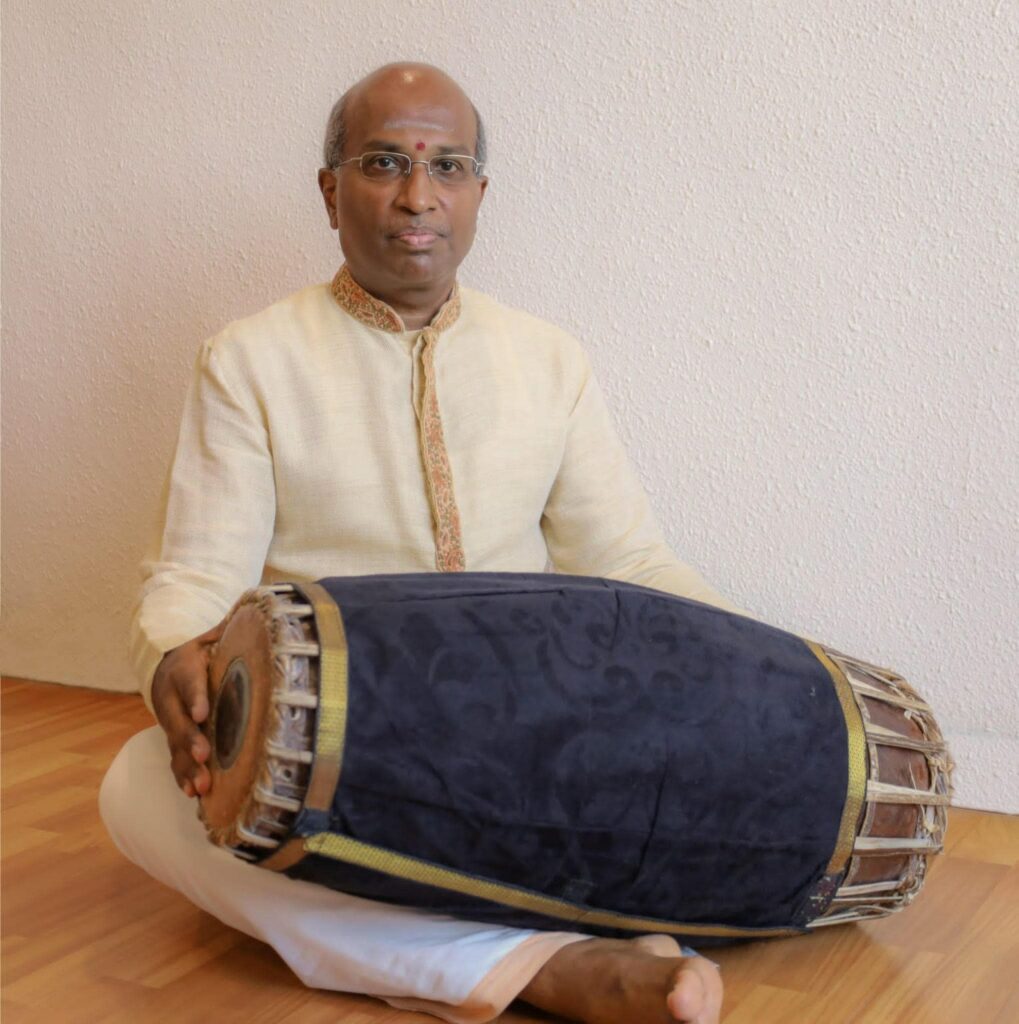
An Interview with Thiruchittampalam Ramanan, considered the Pride of Singapore, a mridangist with over 1500 programmes, in his kitty : By Vidhya Nair Let us start from the very beginning. Tell us about yourself and your family I was born in Malaysia in the 1960s. My father worked for the Malaysian railways and married my mother who was based in Singapore. Eventually, our family settled in Kuala Lumpur (K.L) where I studied before permanently moving to Singapore in the 1980s during my teens. How did you come to be introduced to Carnatic music and the mridangam? Who nurtured your interest? It started with my maternal great-grandfather, Arumugam. He loved Indian Classical music. After he heard that the Music Academy was opening in Madras (now Chennai), he quickly relocated himself from Malaysia to Chennai in the 1930s. He bought a house close to the Academy so that he could attend concerts regularly. He made a serious commitment to study and learn as much as he could.As a retiree, he pursued this knowledge by befriending all book publishers ensuring he would receive the first copy of the first release of any book in the Carnatic Music genre. This resulted in him having a huge collection of rare and acclaimed Carnatic music books. Subsequently, much of his collections were donated to the Music Academy Library in Chennai. He also named his child, my grand uncle, after a famous music composer, Saint Tyagaraja.Although the ancestral roots of my family began in Jaffna, I only visited Jaffna when I went on tour with Apsaras Arts six years ago. A Shiva temple connected with my family still stands in our ancestral village there. I met my wife, Sarada when we were both active in the Singapore Indian Orchestra & Choir (SIOC). She sings and also plays the violin, veena and sitar. My two daughters are also pursuing Carnatic vocal and my elder daughter learnt Bharatanatyam. I am grateful to my family for supporting me to pursue my passion in mridangam. How did you come to learn the mridangam? Tell us about your early learning and teachers? From a young age I was exposed to both Carnatic music and Bharatanatyam. My mother and her sisters learnt both art forms from early classical arts stalwarts of Singapore. They were the pioneer batch who learnt music from the late Pandit Ramalingam together with Vijayalakshmi Sharma and the late V Ramachandran. They also learnt Bharatanatyam from the Bhaskar’s. My grandfather, Dr Balasingham, a pathologist was a patron of the arts and was instrumental in helping K P Bhaskar to perform in K L back in the 1950s. In the early 1960s, my father was posted to Ipoh where he was the President of a local temple. He had the opportunity to learn mridangam soon after he arranged for a mridangam teacher to be brought to Malaya from India. I was drawn to my father’s mridangam at home and used it to accompany my grand-aunt who would sing at home. I was fascinated by its dynamic sound and my interest developed in this nurturing environment. My father further kindled my interest in mridangam by taking me to concerts regularly. I recall watching Madurai Somu and Dr Balamuralikrishna when they performed in K L in the 1970s. We would try to meet the musicians and interact with them. I began learning formally at the age of 12 under a loving guru Thangavelu Vattiyar. In 1980, Flute N Ramani came for a concert in which Karaikudi Krishnamurthy accompanied as a mridangist. My father and I met them and I insisted that I wanted to learn from Krishnamurthy sir after hearing him play. My family encouraged me to continue taking lessons from him throughout my school years. My elder sister became a full time Bharatanatyam teacher with Temple of Fine Arts, Kuala Lumpur till today. Our family treated this pursuit as a divine art, a gift to be nurtured and supported. Several members of my extended family have gone on to pursue music professionally and are promoters in Kuala Lumpur, Perth and elsewhere. Karaikudi Krishnamurthy, your teacher. Share with us your learning years with him? When I met him in 1980 post concert, he told us he had just taken up a position in SIFAS and asked me to take classes there. My father agreed to send me to Singapore. As my father was a Railways employee, I could get free train passage. Initially during school holidays and weekends, I would take the train down on my own and attend Krishnamurthy sir’s classes. As a mridangam student, I would have classes for long hours throughout the day and eventually stayed with sir. He cared for me like his own son and was very loving. SIFAS was at Norris Road then and there weren’t too many students. I was fortunate to meet many Carnatic music stalwarts who performed in Singapore including artistes like K V Narayanaswamy, M L Vasanthakumari, T N Seshagopalan, Dr N. Ramani, Dr L Subramaniam and many more.Krishnamurthy Sir was an amazing and dynamic teacher. He taught spontaneously. He organised many programmes himself and was an active performer both in Singapore and Malaysia. He created korvais in impromptu and taught them along the way to a concert. He expected me to perform what was taught even at these last moments. Over time a group of us formed, my peers were Paskaran, Selvapandian and Devarajan. As I was often called on to practice and perform very regularly, I realised I was in a unique position. Upon Krishnamurthy sir’s insistence, I was exempted from paying fees to SIFAS. I learned under him till he left Singapore in 1988. Apart from playing alongside him on Ghatam or Kanjira at his regular concerts, I was often encouraged to perform as a solo accompanist. Every experience was a lesson in itself. As his live-in companion, he cooked and took care of me. He knew how to motivate; give you challenges and keep you on your toes
From the Desk
In 2016, with an intent to share – and on a timely, regular basis – the many stories brewing in the house of Apsaras Arts, we launched Aavartana, a newsletter, a periodical, literally inspired by the word, Aavartna, a musical term, which literally means cycle of a set rhythmic pattern. As a monthly periodical that arrived at the end of every month in people’s inboxes, Aavartana became the possibility for us to share, report, relay, the world of Apsaras Arts to our rasikas and readers, across the globe. As an international dance repertory company committed equally to performance and education, Aavartana, brought to our own life, a sense of rhythm, and became that channel of communication for us to converse with the arts community in the written word, and do that, in a systematic manner. After a few editions though, life and work came in our way and in 2020, just as we grappled with a pandemic, we returned to a semblance of structure with Aavartana. But like all good ideas that must be nurtured, we are poised in a moment where we are keen to use our standing and reputation, globally, in a manner that is authentic, honest, inspiring and impactful. And it is precisely with this premise that we are proud to present to you Aavartana in an avatar that is anew. Inspired by core principles of objectivity, empathy, inclusivity and a sense of teh accessible, Aavartana in its new format, is more than a mere newsletter that will bring you stories of Apsaras Arts. As a digital magazine that believes in aggregating and presenting the many trends and narratives that make the world of the Indian performing arts so dynamic and exciting, Aavartana will allow readers the possibility of an overview of the people, things and trends simmering in the world of Indian performing arts, dance in particular. Conscious of our readers, of the rushed world we live in and recognising the way we consume news and features today, Aavartana is also excited to unfurl on social media in a way that allows for quick, easy reading for those on the move and like it short, but also cater to readers who still love that feeling that comes from reading a story written in long-form and one that takes more than five minutes. Every edition will feature a cover story that will shed light on a particular idea that is trending in the world of the arts. Our Portrait section features an in-depth interview with an artiste whose story deserves to be told; in our Point of View section, we invite an expert, an artiste to share their perspective on a subject that is pertinent to the world we are in. Three years ago, in December, we introduced a #iamayoungdancer with an intent to create a platform that essentially shared and amplified stories of young dancers from across the world. Our column, The Bookshelf raises a toast to the idea of books and the world associated with it. In our Travel Diaries, we will bring you slices and stories from our own travels and those of other artiste-friends of ours from across the world. In our opening edition, our editorial team insisted this note from me occupies pride of place. Our Portrait this time is T Ramanan, a mridangam artiste with over 1500 performances, worldwide and truly a pride of Singapore. Lata Pada, Bharatanatyam dancer-choreographer-teacher from Canada, shares her perspectives on the pandemic and its impact on dance, and dancers. In our #iamayoungdancer section, two dancers, Periyachi Roshini from Singapore and Rukshikaa Elankumaram from Australia, have a freewheeling conversation on life in dance, and vice versa. For our The Bookshelf section, we reached out to Maya Kulkarni, New York-based dancer-choreographer and academic, to know what she is reading and how her reading inspires her dance. Our Travel Diaries is an in-depth re-visiting of Apsaras Arts’ tour of France, that helped us build connections, meet new audiences, and make memories. We are excited about you reading all that we have compiled for you and we are hoping to build on this editorial platform so Aavartana becomes a part of your life cycle, too! If you like what you read, do take a moment to show us some love! We are hoping to hear from you! Warmly Aravinth Kumarasamy Artistic Director & Editor, Aavartana.
Review of KASI
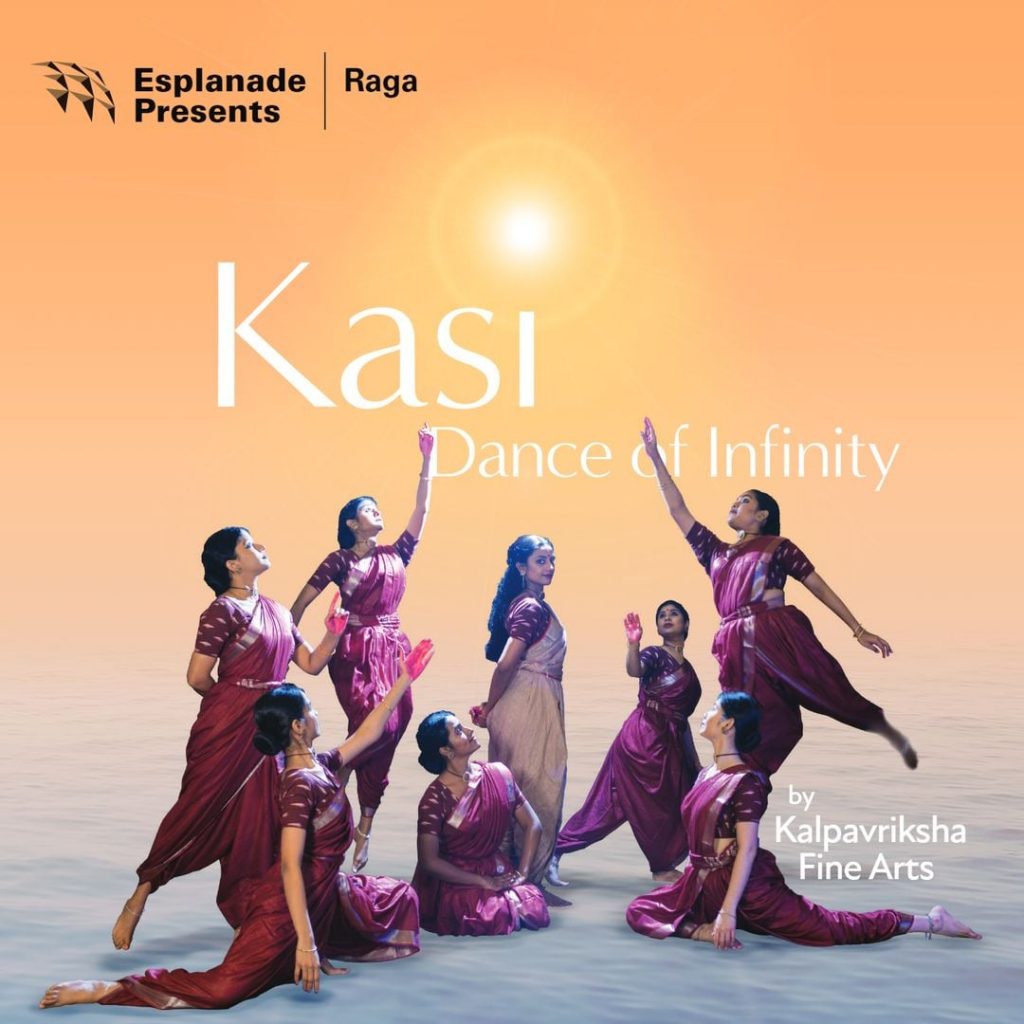
Kasi: A Journey Around & Within Kasi – Dance of Infinity was well-researched, layered and inter-woven in its premise and unfolding, writes Swarnavarsha Gurumoorthy Kasi – Dance of Infinity by Kalpavriksha Fine Arts, presented under Esplanade’s Raaga series is a choreographic work of Meera Balasubramanian under the mentorship initiative as part of Apsaras Arts’s Indian Performing Arts Convention (IPAC) Residency program. Under the guidance of renowned dancer Rama Vaidyanathan, Meera Balasubramanian and her team took the audience through the length and breadth of Kasi, referred to as the spiritual capital of India, letting us journey its vibrant and varied landscape. Divided into four acts, each with a flavour of its own, the production was a celebration of the art of detailing – well-researched and interwoven by Meera, who personified the notion of Kasi. The first act, I am Kasi, opened with the depiction of restlessness within one’s mind, effectively portrayed by the ensemble dancers who broke into a vibrant jathi placing themselves in the formation 8 attempting the establish the idea of infinity. The fluidity in the formations ensured that the varying heights of the supporting dancers were barely significant in the Kasi Panchakam that followed. The second act titled I am Avimukta choreographed with graceful movements glorified goddess Annapurna and her generosity. Act Three began with the process of weaving – thoughtfully conveyed using body movements and adavus with appropriate lighting techniques. To bring in an element of love and union, a Thumri was presented by Meera who wore a purple lehenga like a Kathak dancer, accompanied by the dancers enacting a story of two lovers in the background. This act, I am Benaras ended with Meera presenting a Benaras silk garment that brings a couple (means what?) draws parallels to the rivers, Varun and Asi that unite as Varanasi. The final act, I am Mahasmashaana added vigor after the mellifluous Thumri. The entry was marked by three dancers who moved the audience with their soulful devotion and spiritual ecstasy in a complete trance chanting Kaashikaa-Pura-Adhinaatha-Kaalabhairavam Bhaje. Kalabairava considered the Lord of Kashi, also represents time and breaks the cycle of life and death to attain salvation. A Thillana in ragam Nalinakanthi (composed by Sudha Raghuraman) after that vibrant Kalabairava, offered a different perspective of Kasi with a suggestive depiction of the famous Ganga Aarthi. In an attempt to establish the continuous cycle of time, there were no significant pauses between the acts for the audience to absorb certain aspects of the presentation. The simple aaharya (costume) designed by Meera Balasubramanian and minimalist jewellery not only complemented the mood but also helped the cast execute complex movements with ease. Added to this, the well-seasoned ensemble dancers – Akshaya, Maanasa, Roshini, Preethi, Shobana, Shreya and Soo Mei Fei – maintained high energy levels through the five shows across three days. The musical pieces for the production were carefully chosen from the works of Adi Shankara, Swathi Tirunal, Muthusamy Deekshitar and other eminent composers beautifully arranged and sung soulfully by Delhi-based Sudha Raghuram. One felt that the Thumri could have been handled by a Hindustani singer to add that flavour of a Kathak composition. With Kasi, Meera has established herself as an able choreographer who has the ability to translate her vision, on stage.
Review of Butterfly Lovers
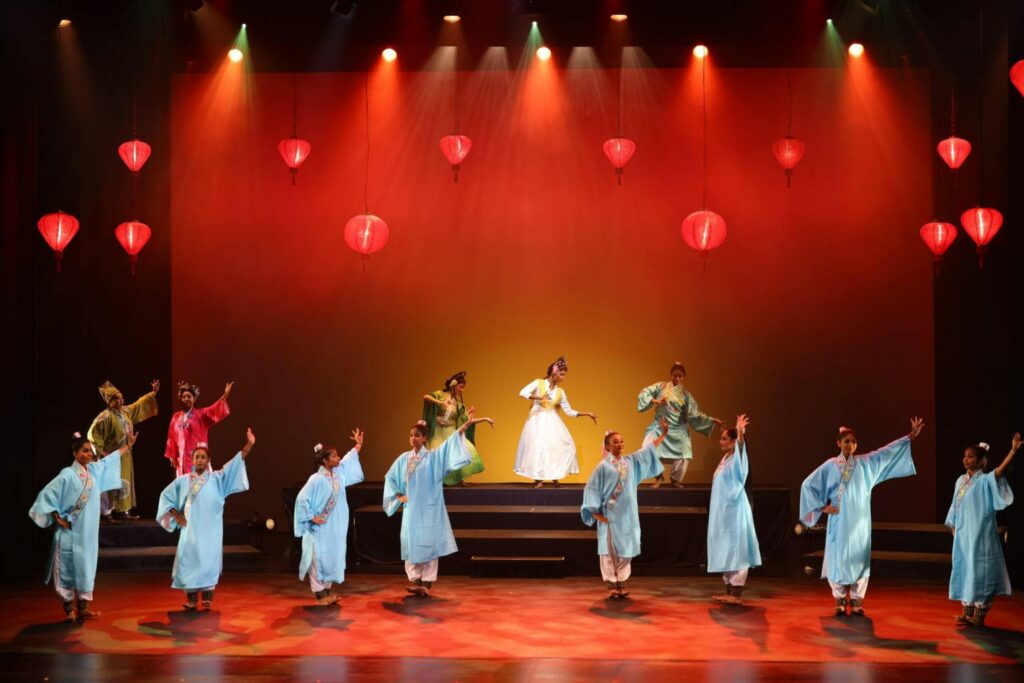
A visual delight but not raising the bar, Swarnavarsha Gurumoorthy breaks down Butterfly Lovers for us… Butterfly Lovers at Victoria theatre, co-presented by Bhaskar’s Arts Academy and Singapore Chinese Cultural Centre was a blend of tradition re-visited almost sixty years since it was first staged. Visualised by Santha Bhaskar in the year 1958 and re-envisaged by her daughter, Meenakshy Bhaskar in 2021, this version combined both the Chinese and Indian dance styles. Dating from the Tang Dynasty, the Butterfly legend talks of Zhu Yingtai and Liang Shanbo, whose relationship is delayed when Zhu cross-dresses as a boy to enter school. This obstacle is removed; Zhu’s father arranges her marriage to a wealthy man. Learning of the news, Liang dies, with Zhu following in suicide. The duo is re-incarnated as loving butterflies. The first act set is a perfect ambience for this Chinese Romeo- Juliet with musician Neil Chua’s soulful performance on the ruan (a Chinese instrument). Within the performance, the set design is also crucial to bring the visual experience to the next level. The stage props such as the traditional Chinese lanterns in a few scenes and dangling creepers in others, successfully created an artistic conception for the audience. Another highlight was the three-dimensional effects in the background that further amplified the scenic beauty. In an effort to blend both styles, the dancers in traditional Chinese attires with salangais, attempted some “Indianized Chinese dance movements” which became repetitive after a point. There were some lively moments during Yingtai’s and Shanbo’s school years along with other scholars which engaged the audience and brought some laughter. Malini Bhaskar as Shanbo and her perfect chemistry with Sarenniya Ramathas as Yingtai reflected extensive years of them dancing together. Their apparent confidence in each other as dancers coupled with pirouettes added dynamism in contrast to the amateur supporting characters and dancers. he scene where Shanbo becomes an alcoholic was thoughtfully planned with only the ruan being played to the viraha portrayed by Malini Bhaskar. The choreography for the Thillana performed by the leading duo seemed to have a lot of packed adavus resulting in some unfinished movements. The musical score for this re-visit is by the renowned music composer Rajkumar Bharathi. This combination of alternating Chinese and Indian music hardly resonated with the theme and was ineffective in creating an emotional impact. The Tamil lyrics and dialogues in the presentation lacked depth in terms of poetry and the choice of words. To sum up, Butterfly Lovers was a delight to watch in terms of aesthetic stage settings, creative visuals and the dynamic lead duo in perfect unison with each other. While Sreejith Krishna’s Don Quixote that premiered in 2015 broke new ground in uniting Indian classical dances with contemporary performance and storytelling elements, this choreographic work of a Young Artist Award recipient missed out on setting high standards. Review is by our young dance-critic-in-the-making, Swarnavarsha Gurumoorthy, recipient of Dr Sunil Kothari Dance Journalism Scholarship by Apsaras Arts. DISCLAIMER: The views and opinions expressed in this review are those of the reviewer and do not represent the views and opinions of Apsaras Arts Ltd. All rights reserved.
Periyachi Roshini Arangetram Review
Periyachi Roshini enthralled the audience with her infectious energy and soulful abhinaya, writes Swarnavarsha Gurumoorthy The Mahatma Gandhi Memorial Hall, Singapore, recently hosted its first-ever performance – Bharatanatyam Arangetram of Periyachi Roshini, student of Singapore Indian Fine Arts Society (SIFAS) under the tutelage of Geethanadhan PK. Saraswathi Sthuthi in ragam Saraswathi set to Rupaka Talam ,composed by the legendary GN Balasubramaniam was an energetic start for the recital which had some innovative adavu patterns in the swarams. This kriti glorifying Goddess Saraswati was set to dance by Geethanadhan who gave the nattuvangam support for the evening. In the Varnam, Adi Sivane in ragam Thodi set to Adi Talam, a composition of the maestro KN Dandayudapani Pillai, Roshini effortlessly played a nayika (heroine) who yearns for the formless Adi Sivan dancing in Chidambaram. The sancharis in the first half were aptly chosen though there could have been a longer teermanam on the mridangam before the start of the second half of the Varnam. The jathi compositions by Kiran R Pai coupled with intricate cross patterns might have been a bit challenging for Geethanadhan on the nattuvangam, but the Varnam was testimony to his confidence and imagination as choreographer. Chinnanchiru Kiliye played by the instrumentalists kept the audience engaged until she Roshini got back on stage with the Padam – Varugalaamo Ayya in ragam Manji set to Misrachapu, a composition of Gopalakrishna Bharati. Narrating the story of Nandanar, an outcast who was denied entry into the Chidambaram temple, Roshini immersed herself in this abhinaya piece choreographed by Neewin Hershall under whom she trained previously. This soulful piece clearly showed her mastery over facial expressions and also created a personal connection with the audience. The fast-paced Keerthanam, Gaana Mazhai in ragamalika set to Rupaka Talamby Ambujam Krishna described the music emanating from Krishna’s flute and the magic it creates. This rare, novel Keerthanam, musically delightful, was choreographed with alternating vivacious movements and a few hurried abhinaya sequences that in hindsight, could have been slower. Roshini’s crowning glory though was the confidence with which she handled this Keerthanam. The dancer then went on to portray a nayika who questions her beloved Lord Krishna who seems a bit indifferent to her in the famous Javali, Parulanna Maata in ragam Kapi set to Adi Talam, a composition by Dharmapuri Subbaraya Iyer. As she performed this choreography of Bragha Bessel, the spontaneous switching between the characters was distinct and flawless. Her attention to detail to effectively depict the characters is highly commendable. Concluding with a Thillana by Patnam Subramanya Iyer in ragam Khamas set to Adi Talam in a the energy with which the piece was choreographed by Geethanadhan showed her command over nritta with neat adavus, controlled leaps and clear finishes. Well balanced stamina, engaging, intriguing adavu patterns and the ease with which Roshini presented her Arangetram, is reflective of her rigorous training along these years under many teachers. The lighting for the evening was well-managed. This being the first performance in the venue, there were sound balancing issues. The impressive orchestra team included T Ramanan on the mridangam who was an asset, accompanied by TP Nishanth (vocal) Niranjan Pandian(flute) and Ganesh Kumar NNR (violin).
Appointment Announcement- Sankari Elavalahan as Company Manager at Apsaras Dance Company

We are excited to share the announcement of the appointment of Sankari Elavalahan as the Company Manager of Apsaras Dance Company. Sankari Elavalahan embarked on her arts journey as a bharatanatyam student at the tender age of 5 with Apsaras Arts. Sankari has completed a formal Bharatanatyam training under the tutelage of Mrs Neila Sathyalingam and staged her graduation debut performance Arangetram “Aadal Kaaneero”, themed based on popular dance music compositions that were featured on Tamil films. Sankari has served various government organisations such as Civil Aviation Authority Singapore (CAAS), Singapore Indian Development Association (SINDA), National Library Board (NLB). While she was working full time, she continued to be part of the arts scene as a dancer and Image Stylist for theatre drama productions. She is also a professional Make-up artiste graduated from Cosmoprof Beauty Academy in 2011. Sankari joined Apsaras Arts in 2017 as the company’s Admin Assistant. The following is the brief details of her achievements. Performance Artiste: Sankari has spent her growing years being part of Apsaras Arts performances and productions namely, Chidambara Ragasiyan, Sivagami and Aalam. She was also initiated at the age of 13 by Mrs Neila Satyalingam to join the People’s Association Indian Dance Company. Trained in semi-classical, folk (devarattam and kalaripayat) Neo- bharatam, Bollywood and Hip- Hop styles, Sankari has represented the troupe locally and internationally at several arts festivals, Chingay and National Day parades, community events and conferences. Sankari was the appointed Vice- President (2005-2006) of Temasek Polytechnic Indian Dance Group which won Best Arts Group of 2006 during her tertiary education. Arts Administrator: Sankari has been responsible for the overall administration of the Apsaras Dance Company and Apsaras Arts Academy since 2017, managing administration and logistics functions. She has also headed the event management of the company’s events including the annual Indian Performing Arts Convention (IPAC), DARSHANA and NADOPASANA series. Sankari, has been responsible for the company’s international tour arrangements. She has also been assisting in the Company’s fund raising initiatives over the years. Make-up Artiste: Sankari has served as the dance company’s make-up artiste over the years for the performances in Singapore and on international tours, including for digital films and television programs. Her talent in bringing out the natural beauty of the dancers while adapting the make-up style to suit the theme and narrative of each dance production has been acclaimed by art connoisseurs. Please join us in celebrating the appointments of Mohanapriyan Thavarajah, Seema Hari Kumar and Sankari Elavalahan. Their passion for creativity, dedication, and commitment for excellence are truly commendable. Here’s to many more achievements and inspiring moments in their journey with the Apsaras family!
Appointment Announcement- Seema Hari Kumar as Vice Principal at Apsaras Arts Academy
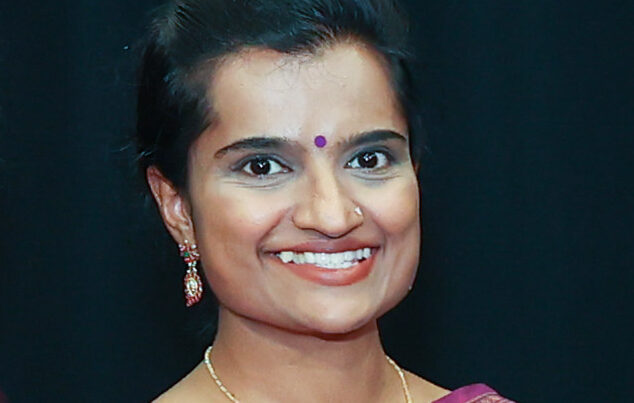
We take great pride in announcing the appointment of Seema Hari Kumar as the Vice Principal, at Apsaras Arts Academy. Having started as a student of dance at the Apsaras Arts in 1993, she graduated under the tutelage of our founder Mrs Neila Sathyalingam. Seema has been casted as a dancer in almost all of the repertory works of Apsaras Dance Company. Seema has been on the teaching faculty of the Apsaras Arts Academy since 2003. Today, Seema is a key member of the organisation and also the master of ceremonies at key events. Here is a summary of her achievements and contributions. Teaching Faculty: Seema began inspiring and teaching Bharatanatyam to young students under the guidance of her guru Mrs Neila Sathyalingam and is now one of the Academy’s senior faculty member. Under her tutelage, many students have been nurtured and groomed to blossom as aspiring young dancers. She has presented her students in their graduation performance – Arangetram and several other students are currently being prepared for their Arangetrams too. In 2012, when the academy launched a unique training program – Bala Bharatham, specifically created for young kids between the ages of 4-6 years, Seema spearheaded this program and created the syllabus and its pedagogy and ran this course. Today, this course is one of the iconic courses art Apsaras Arts Academy and has a popular enrolment year after year. Seema also serves as the member of the team of faculty at Indian Performing Arts Convention (IPAC) in Singapore and Melbourne. Performing Artiste: Seema performs extensively with Apsaras Dance Company and has travelled with company on its international tours across Asia, Europe and Australia, including for the recent performance of the cross cultural collaborative production ARISI : RICE presented by the Music Academy Madras, India, in January 2024. She has also performed for numerous collaborations with Singapore’s Malay and Chinese choreographers over the years, and was also the member of the Singapore’s People’s Association’s Indian Dance Company helmed by Mrs Neila Sathyalingam as its resident choreographer for two decades. Choreographer: Seema has been choreographing for student’s performances for the academy’s performances at community events and television programs. She was one of the early Singaporean artistes to create a own choreographic work “Mohini” under the mentorship of internationally acclaimed choreographer-dancer Priyadarsini Govind for the IPAC residency program, which was presented in Singapore, India and Australia.